

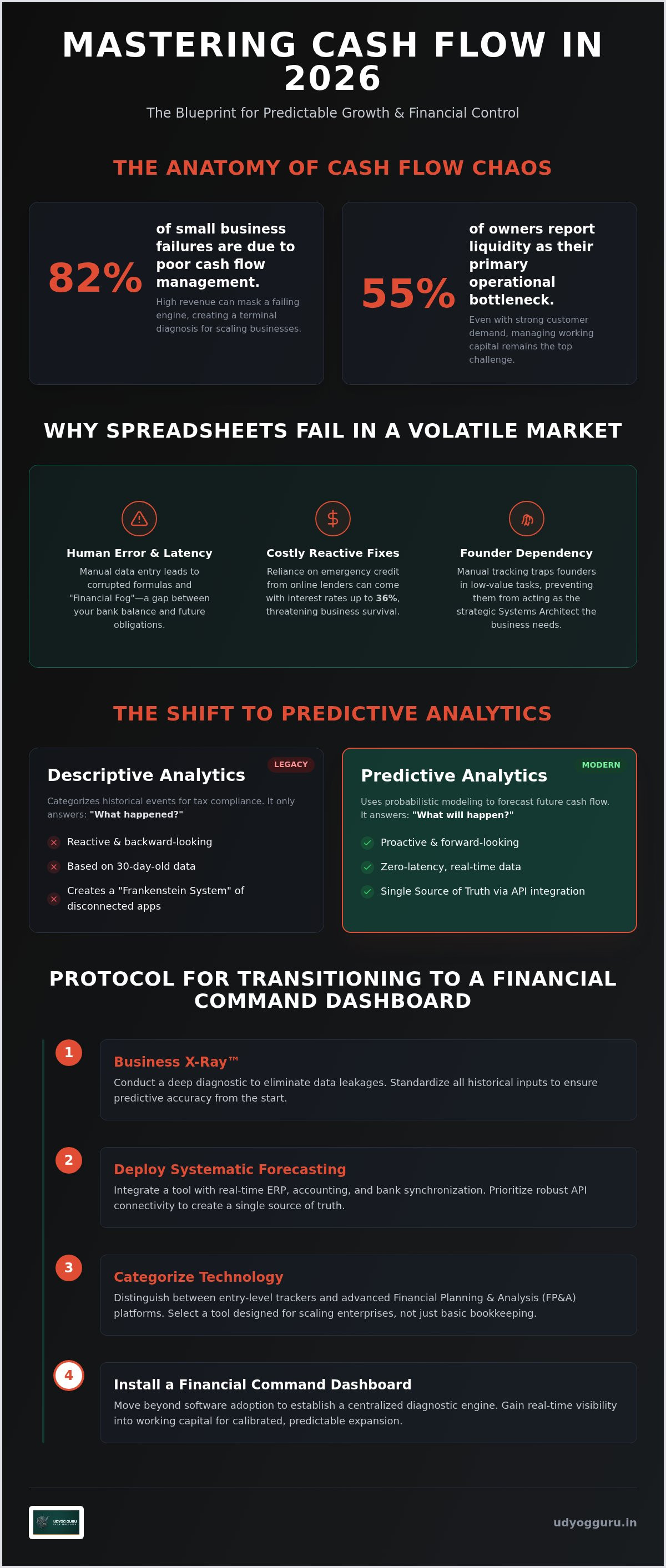
Did you know that 82% of small business failures in 2026 are still attributed to poor cash flow management? Even with strengthening customer demand, 55% of business owners report that liquidity remains their primary operational bottleneck. High revenue often masks a failing engine, where manual spreadsheet errors and delayed visibility create a terminal diagnosis for scaling. To survive this landscape, you must implement cash flow forecasting for predictable growth as a core structural requirement rather than a secondary bookkeeping task.
You likely recognize the exhaustion of firefighting cash crunches while your bank balance remains a mystery until month-end. This guide provides the systematic framework for selecting cash flow management tools that transform raw financial data into a high-precision predictive engine. We'll examine how to install a Financial Command Dashboard that offers real-time visibility into your working capital. By the end of this analysis, you'll understand the architecture needed to move from reactive survival to a state of calibrated, predictable expansion.
Key Takeaways
- Identify why manual spreadsheets and bank-balance management create operational latency and structural vulnerabilities in the 2026 economic environment.
- Deploy a systematic framework for cash flow forecasting for predictable growth by integrating real-time ERP synchronization and probabilistic AI modeling.
- Categorize the current technology landscape to distinguish between entry-level automated trackers and advanced FP&A platforms designed for scaling enterprises.
- Execute a multi-stage transition protocol, beginning with a Business X-Ray™ to eliminate data leakages and standardize historical inputs for predictive accuracy.
- Install a Financial Command Dashboard to move beyond mere software adoption and establish a centralized diagnostic engine for real-time capital control.
The Anatomy of Cash Flow Chaos: Why Spreadsheets Fail in 2026
Managing a business by bank balance is a clinical pathology known as the Blinded Founder syndrome. In this state, a leader mistakes current liquidity for structural health, ignoring the underlying physiological trends of the enterprise. This approach is purely reactive; it fails to account for the "engines" of the business that consume capital long before revenue is realized. Relying on a static bank statement is like attempting to navigate a high-speed vehicle while looking only at the rearview mirror. To achieve true operational control, cash flow forecasting must function as a diagnostic sensor that scans for future liquidity gaps.
Manual spreadsheets, once the standard for financial modeling, have become a structural liability in 2026. They are prone to human error and lack the capacity for complex scenario modeling required in a volatile market. When data is entered manually, the risk of "key-person" failure increases exponentially. If a single formula is corrupted or a line item is missed, the entire projection becomes a false positive, leading to poor capital allocation and a reliance on expensive emergency credit. With interest rates for online lender term loans reaching up to 36% in 2026, the cost of reactive management is no longer just a nuisance; it is a threat to the business's survival.
The Latency Problem in Financial Reporting
Scaling enterprises often suffer from data silos where sales, procurement, and accounting departments operate on different timelines. This fragmentation creates a latency effect where financial reports are based on 30-day-old data, making them functionally useless for real-time decision making. Financial Fog is the gap between current bank balance and future obligations. Without a synchronized system, this fog thickens, obscuring the path toward sustainable expansion. Implementing cash flow forecasting for predictable growth requires a shift toward zero-latency data integration that reflects the current state of every acquisition funnel and operational protocol.
Founder Dependency and Manual Systems
Manual cash tracking traps the founder in low-value operational tasks, preventing them from acting as the Systems Architect the business requires. Every hour spent reconciling a spreadsheet is an hour lost to strategic calibration. Shifting from person-dependent tracking to a system-dependent architecture ensures that financial visibility is not tied to an individual's manual labor. A robust system provides a "Financial Command" view that persists regardless of who is at the keyboard. This transition is essential for building a machine that can scale without constant founder intervention, turning financial data into a reliable engine for acceleration.
Diagnostic Criteria for Selecting Cash Flow Management Tools
Selecting a cash flow management tool is not a procurement exercise; it is a structural calibration of your business engine. To achieve cash flow forecasting for predictable growth, the selected software must meet specific diagnostic criteria that ensure data integrity and predictive accuracy. A tool that fails to synchronize in real-time with your ERP and bank accounts creates a latency gap that renders any projection obsolete before it is even viewed. The primary requirement for 2026 is zero-latency data, where every transaction is immediately reflected in the business's financial architecture.
Integration Protocols with Existing Tech Stacks
The architecture of your financial system must rely on a Single Source of Truth to prevent operational friction. Many SMEs fall into the trap of building a "Frankenstein System," where disconnected apps for sales, procurement, and accounting create data silos and reconciliation errors. When evaluating tools, founders must prioritize API connectivity with both local Indian accounting software and global ERPs. This seamless integration ensures that the diagnostic scans you perform yield accurate results rather than a fragmented picture of your capital health. A robust integration protocol eliminates manual data entry, which is the primary source of human error in financial modeling.
Predictive vs. Descriptive Analytics
Most legacy systems offer descriptive analytics, which merely categorize historical events for tax compliance. While understanding what happened is necessary, it is insufficient for the purpose of business acceleration. Predictive analytics use probabilistic modeling to forecast customer payment behaviors and vendor cycles based on real-time data. You should prioritize features such as automated burn rate alerts, rolling runway projections, and tax liability forecasting, especially given the 21% federal corporate tax rate for the 2026 tax year. "A dashboard that only shows the past is a rearview mirror, not a navigation system."
Beyond data processing, the tool must offer scenario planning capabilities. This allows you to stress-test your business engine by modeling "what-if" scenarios, such as a 20% increase in raw material costs or a 15% delay in client payments. Finally, the user interface must provide clarity within 60 seconds. If a founder cannot diagnose the current liquidity state at a glance, the tool has failed its primary purpose. For those seeking this level of operational control, installing a Financial Command Dashboard provides the necessary diagnostic sensors to navigate market volatility with confidence.
Categorizing the 2026 Cash Flow Technology Landscape
The 2026 technology landscape is defined by four distinct tiers of operational maturity. Selecting the wrong tier is a diagnostic error that leads to either data starvation or system bloat. To implement cash flow forecasting for predictable growth, you must align the tool's complexity with your business's current architectural requirements. This categorization ensures that your financial "engine" has the necessary sensors without unnecessary mechanical friction.
Tier 1 consists of Entry-Level Automated Trackers, which serve as the first step for founders migrating away from manual Excel models. Tier 2 encompasses Mid-Market FP&A (Financial Planning & Analysis) Platforms, designed for scaling enterprises that require multi-departmental coordination. Tier 3 includes Enterprise Treasury Management Systems (TMS), which are necessary for complex, multi-entity organizations managing global liquidity and currency volatility. Finally, Tier 4 represents the 2026 frontier: Specialized AI-Native Liquidity Engines. These autonomous systems perform real-time probabilistic modeling, adjusting capital allocations without human intervention to optimize for both yield and liquidity safety.
Automated Trackers for Emerging Enterprises
Emerging enterprises with 10 to 50 employees often operate in a state of financial fog due to manual reconciliation latency. Automated trackers eliminate this bottleneck by providing direct bank feeds and automated transaction categorization. These systems act as basic diagnostic sensors, giving founders immediate visibility into their current liquidity. Establishing this baseline is a prerequisite for learning how to track business profitability through a disciplined, data-driven protocol. By automating the descriptive phase of accounting, these tools free up founder bandwidth for higher-level strategic calibration.
Strategic FP&A Platforms for Scaling Systems
Scaling enterprises require more than simple tracking; they need a robust architecture for complex departmental budgeting and multi-scenario forecasting. These strategic platforms are integral to the Business Acceleration Engine™ framework, providing the predictive clarity needed to manage rapid expansion. They allow for the simulation of probabilistic outcomes, such as the impact of shifting interest rates or supply chain disruptions. In the 2026 credit market, where lenders demand high-fidelity data for debt restructuring, these platforms are essential for securing external funding. They transform the finance function from a reporting cost center into a predictive navigation system that supports aggressive, yet safe, scaling protocols.
Protocol for Transitioning to Predictive Cash Flow Management
Transitioning to a predictive model requires more than a software subscription; it demands a clinical installation of new operational protocols. To achieve cash flow forecasting for predictable growth, founders must move through a four-step diagnostic sequence. The first step involves conducting a Business X-Ray™ to identify existing data leakages, such as unreconciled accounts or ghost subscriptions that siphon capital. Once these leakages are neutralized, the second step is to clean and standardize historical data. Modern AI-driven tools require high-fidelity historical inputs to calibrate their probabilistic engines.
The third step focuses on defining 'Command Metrics.' These are the 3 to 5 critical numbers, such as your current burn rate and Days Sales Outstanding, that dictate the structural health of your enterprise. Finally, you must pilot your selected tool using a 13-week rolling forecast protocol. This specific duration provides enough tactical visibility to adjust procurement and sales strategies before a liquidity crisis occurs. Moving through these steps ensures that your financial data is no longer a static record but a dynamic engine for acceleration.
The 13-Week Rolling Forecast Methodology
A 13-week window is the 'Goldilocks' zone for tactical financial planning. It covers a full fiscal quarter. This allows you to align your forecast with existing sales funnels and procurement cycles. This methodology moves the business away from static annual budgets toward a dynamic, living model. Success relies on the ritual of a 'Weekly Financial Review' where the leadership team analyzes variances between the forecast and actual performance. This discipline ensures that the business engine remains calibrated to market realities and capital requirements.
Standardizing Financial Operating Procedures (SOPs)
System-dependent architecture requires clear roles and automated validation protocols. You must define exactly who is responsible for data entry and who performs the final diagnostic interpretation. Without standardized SOPs, even the most advanced tools will produce 'dirty' data, leading to flawed decision-making. This process is essential for identifying operational bottlenecks in business before they escalate into systemic failures. To begin your transition with professional guidance, you can schedule a Business X-Ray™ diagnostic session to map your current financial architecture and identify structural vulnerabilities.
Installing the Financial Command Dashboard for Scalable Growth
Installing a tool is a mechanical act, but achieving operational command is a systemic one. Software represents only 20% of the solution. The remaining 80% resides in the installation of rigorous protocols that turn raw data into actionable intelligence. The Financial Command Dashboard functions as the central nervous system of your enterprise, aggregating data from the diagnostic sensors discussed in previous sections. By centralizing these inputs, you move from reactive bookkeeping to cash flow forecasting for predictable growth, where every financial movement is a deliberate step in a larger architectural plan. This transition is vital in 2026, where the federal C corporation tax rate of 21% and high interest rates for online lender term loans, often reaching 36%, leave no margin for structural inefficiency.
The Founder’s Command Center: 60-Second Clarity
A properly architected financial dashboard for business owners eliminates the cognitive load of navigating fragmented spreadsheets. In 2026, a founder's time is best spent on high-level calibration rather than data mining. The Command Center provides a high-fidelity visualization of your business's physiological state, allowing for a complete diagnosis in under 60 seconds. This visibility is the catalyst for faster, more aggressive scaling decisions. When you can see your runway and burn rate in real-time, you remove the hesitation that typically precedes significant capital allocation. It's about having a "Financial Command" view that renders the old "management by bank balance" obsolete.
Engineering Predictability into the Business Machine
Predictability isn't a matter of luck; it's a result of precise financial engineering. By integrating real-time cash flow data into the Business Acceleration Engine™, you can establish automated triggers for operational expansion. For instance, specific liquidity thresholds can automatically initiate recruitment protocols or increase marketing spend within your acquisition funnels. This systematic approach transitions the founder from a state of constant survival to a position of market architect. You aren't just reacting to the economy; you're engineering a machine that thrives within it. Every component, from procurement cycles to sales velocity, must be calibrated to ensure the engine doesn't seize during a growth spurt. To ensure your business is structurally sound for this level of acceleration, you should audit your business systems with Udyog Guru to identify and repair any remaining inefficiencies before they become catastrophic.
Calibrating Your Financial Engine for Systemic Expansion
The transition from manual, person-dependent tracking to a system-dependent architecture is a structural requirement for the scaling enterprise. We have established that spreadsheets are a liability in the 2026 economic environment, whereas real-time synchronization and probabilistic AI modeling act as the primary diagnostic sensors for your business engine. By installing a 13-week rolling forecast protocol and a centralized dashboard, you move beyond reactive firefighting into a state of calibrated control. This systemic approach to cash flow forecasting for predictable growth ensures that your capital remains a fuel for acceleration rather than a source of operational friction.
To achieve this level of precision, you must audit your existing financial architecture for data leakages and structural vulnerabilities. Udyog Guru provides the proprietary Business X-Ray™ diagnostic tool and India's leading business transformation framework to facilitate this transition. Our AI-ready financial integration protocols are designed to remove founder dependency and install a permanent state of fiscal clarity. Architect your Financial Command Dashboard with Udyog Guru and turn your financial data into a high-performance engine for sustainable scaling. Your business is a machine; it's time to calibrate it for peak efficiency.
Frequently Asked Questions
What is the difference between cash flow tracking and cash flow forecasting?
Tracking is a descriptive diagnostic that records historical capital movement for tax compliance and basic reconciliation. In contrast, cash flow forecasting for predictable growth is a predictive protocol that uses probabilistic modeling to project future liquidity based on current acquisition funnels and procurement cycles. Tracking tells you where your money went; forecasting tells you where your business engine is headed before you hit a liquidity bottleneck.
Can AI tools accurately predict cash flow for seasonal businesses?
Modern AI liquidity engines excel at identifying non-linear patterns that manual spreadsheets often miss. By analyzing years of historical data, these systems can account for cyclical volatility and adjust projections with higher accuracy than traditional linear models. This allows seasonal businesses to calibrate their burn rates and inventory levels during off-peak periods, ensuring the structural integrity of the business machine remains intact year-round.
How much should a mid-sized company spend on cash flow management tools?
Investment varies based on the complexity of your financial architecture. Entry-level automated trackers like Float start at approximately $25 per month, while more robust platforms like Pulse or Cash Flow Frog range from $59 to $69 per month. Scaling enterprises requiring deep integration often invest in Comprehensive or Ultimate plans from providers like Xero, which cost between £55 and £70 per month as of late 2026. The goal is to match the tool's cost to the ROI of gained operational clarity.
Do I need to replace my existing accounting software to use a forecasting tool?
You don't need to replace your core accounting software if it supports modern API connectivity. Most advanced forecasting tools are designed to sit on top of existing ERPs and accounting platforms as a diagnostic layer. This creates a Single Source of Truth architecture where data flows seamlessly from your ledger to your predictive dashboard. The focus should be on integration and system-dependent architecture rather than a total software overhaul.
How often should a founder review the cash flow forecast?
A founder should conduct a high-level diagnostic review of the 13-week rolling forecast at least once per week. This weekly ritual ensures that any variances between projected and actual capital movement are identified and repaired immediately. While the Financial Command Dashboard provides real-time visibility, a dedicated weekly session allows the leadership team to make calibrated adjustments to marketing spend, hiring, and procurement before they impact the business's runway.
What are the common pitfalls when implementing automated financial systems?
The primary pitfall is the "Frankenstein System" where disconnected apps create data silos and reconciliation latency. Another common failure is relying on automated tools without establishing standardized Operating Procedures (SOPs). If the data entering the system is "dirty" or inconsistent, the resulting forecast will be a false positive. Success requires a Business X-Ray™ to identify these structural gaps before installing new technology, ensuring the system remains reliable and founder-independent.
Is it possible to automate cash flow forecasting without a full-time CFO?
It's entirely possible to achieve high-level financial command without a full-time CFO by installing a system-dependent architecture. Tools like the Financial Command Dashboard automate the data aggregation and visualization processes that a CFO would traditionally handle manually. By utilizing cash flow forecasting for predictable growth, a founder can maintain diagnostic control over the business machine using automated triggers and real-time visibility, reducing the need for expensive executive overhead during the early scaling phases.
How do cash flow tools help in securing business loans in India?
Lenders in India increasingly prioritize high-fidelity, real-time data over static historical balance sheets. In a 2026 environment where bank term loans average 8% to 17.25% interest, providing a transparent, automated forecast demonstrates operational maturity and reduces the lender's perceived risk. Having a robust financial dashboard allows you to present a clear plan for capital utilization, which is essential for securing favorable rates on commercial mortgages or lines of credit during expansion.


