
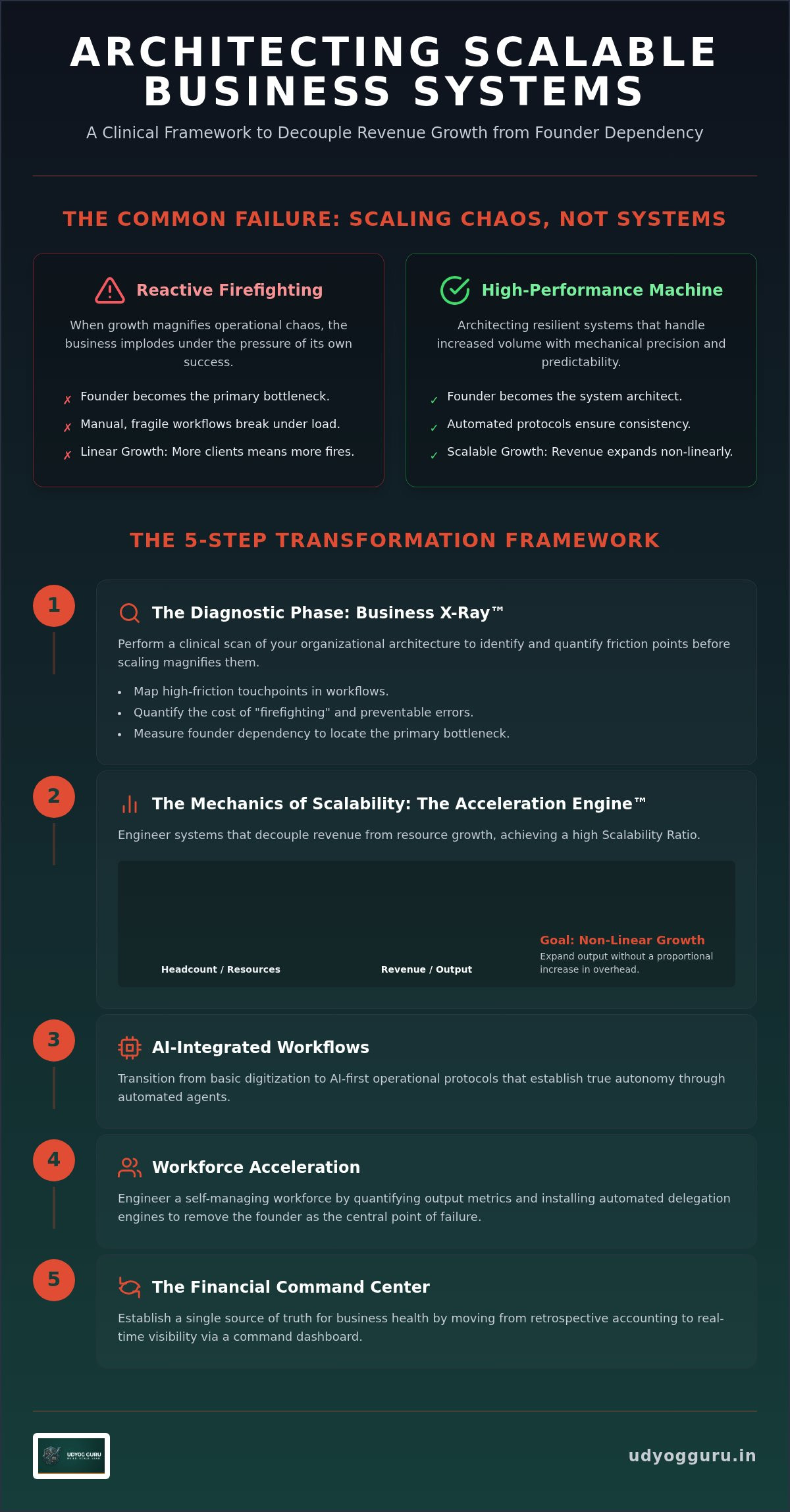
Most SMEs don't fail because of a lack of market demand; they implode because their internal architecture cannot withstand the structural pressure of its own success. If every new client acquisition currently magnifies your operational chaos, you aren't running a business; you're managing a series of reactive fires. It's a common diagnostic finding for founders who feel trapped in a growth plateau where their personal involvement remains the only thing keeping the engine from seizing. You likely recognize that your current manual protocols won't survive the transition to 2026's digital requirements.
This article delivers the clinical framework for architecting scalable business systems for SMEs that effectively decouple revenue growth from founder dependency. We'll move past motivational fluff to provide a rigorous, data-driven roadmap for installing operational autonomy. By following this systematic approach, you'll learn how to replace fragile, intuition-based workflows with a high-performance machine. We'll preview the essential components of a modern digital transformation, from initial diagnostic scans to the full installation of automated acceleration engines designed for sustainable, predictable expansion.
Key Takeaways
- Conduct a clinical scan of your organizational architecture to identify friction points before they compromise your growth.
- Architect scalable business systems for SMEs that optimize your scalability ratio, allowing revenue to expand without a linear increase in headcount.
- Transition from basic digitization to AI-first operational protocols that establish true autonomy through automated agents.
- Engineer a self-managing workforce by quantifying output metrics and installing automated delegation engines to remove the founder as a bottleneck.
- Establish a single source of truth for your business health by moving from retrospective accounting to real-time visibility via a command dashboard.
The Diagnostic Phase: Identifying Operational Friction Before Scaling
Scaling is not a linear exercise in adding resources; it's a stress test of your existing architecture. Most founders attempt to build scalable business systems for SMEs by simply increasing input, but this approach backfires when the underlying framework is fractured. Scaling a broken system doesn't lead to growth. It leads to a magnification of operational chaos and accelerated financial leakage. Before any installation of growth technology, a clinical scan is required to identify the friction points that will inevitably seize the engine under higher pressure. Pursuing business scalability without a stable foundation is a recipe for systemic failure.
We define this process as the Business X-Ray™. This isn't a motivational review; it's a rigorous, evidence-based diagnostic protocol designed to surface hidden inefficiencies. One of the most critical findings in this phase is the "Founder Bottleneck." By performing a quantitative operational auditing process, we can measure exactly how much the business relies on the founder's manual intervention. If your presence is the primary lubricant for your lead-to-delivery workflow, your business isn't scalable; it's a high-maintenance job that will eventually collapse under its own weight. We look for the "single point of failure" where decision-making is concentrated rather than distributed through automated protocols.
Anatomy of an Operational Audit
An effective audit maps every high-friction touchpoint within your current workflows. We examine the lead-to-delivery pipeline to find where data stalls or where manual hand-offs create errors. The goal is to quantify the cost of "firefighting." When staff spend significant portions of their day correcting preventable errors, that's a direct drain on your scaling potential. You can explore our specific Business Diagnostic Scan methodology to understand how we engineer operational clarity for scaling enterprises through systematic repair.
The Science of Transparency
Transparency is the antidote to operational anxiety. A diagnostic scan reveals exactly where workforce allocation is misaligned with your growth targets for scalable business systems for SMEs. Most SMEs operate on "feelings." Founders feel overwhelmed, so they hire more staff. This is a reactive error that often introduces more complexity without solving the root cause of the friction.
By moving to a dashboard-driven view, you start seeing the structural gaps. You transition from intuitive management to a "Systems Architect" mindset where data dictates the repair. The Business X-Ray™ is a non-negotiable prerequisite for any scaling effort because you cannot repair what you haven't first diagnosed.
The Mechanics of Scalability: Decoupling Revenue from Resource Growth
True scalability is defined by the "Scalability Ratio": the ability to expand output and revenue without a proportional, linear increase in headcount or overhead. For most organizations, growth is an expensive, friction-heavy process where every new client necessitates a new hire. This is a structural defect. To achieve scalable business systems for SMEs, you must install the Business Acceleration Engine™. This system functions as the central mechanism for automating core growth drivers, ensuring that your acquisition and delivery protocols operate with mechanical precision regardless of volume. By decoupling revenue from labor, you transform the business from a person-dependent entity into a high-performance machine.
Structural Engineering for Growth
Architecting a scalable business architecture requires adopting a "Business Format Franchise" mindset, even if you don't intend to franchise. This model treats every operational component as a repeatable, modular protocol that functions independently of specific individuals. When your infrastructure is standardized, you can upgrade specific modules, such as your lead-to-delivery workflow, without halting the entire operation. This modularity is essential for sustainable enterprise expansion because it allows for the clinical replacement of inefficient parts as the business reaches new tiers of complexity.
Removing Linear Dependency
Hiring more people is often a "band-aid" for poor system architecture. When a process is broken, adding headcount only magnifies the existing chaos. Data from the OECD regarding the digital transformation of SMEs suggests that technology must serve as a force multiplier for your existing workforce. Instead of manual oversight, you must transition to system-driven accountability where the protocol, not the manager, dictates the next action. This shift reduces the "management tax" that typically erodes profit margins during periods of rapid growth.
By leveraging technology as the primary engine of execution, you ensure consistent quality across all customer segments without increasing your personal workload as a founder. If your current growth feels chaotic, it's time to audit your scaling readiness before adding more weight to a fragile structure. Establishing scalable business systems for SMEs is not about working harder; it's about engineering a system that works on your behalf, allowing for predictable and sustainable revenue growth through 2026 and beyond.
2026 Trends in Digital Transformation: The Shift to AI-Integrated Workflows
The roadmap for 2026 demands a transition from basic digitization to AI-first operational protocols. Basic digitization, which involves simply moving paper records to digital databases, is no longer a competitive advantage; it's a baseline. To develop truly scalable business systems for SMEs, you must move toward "Operational Autonomy." This involves deploying AI agents and low-code automation to handle repetitive decision-making and client interactions. By integrating these intelligent layers, you ensure the business machine continues to function at peak capacity without requiring manual oversight for every transactional event.
Our AI Tech Business Integration Bootcamp serves as the technical bridge for this transition. It's designed to remove the traditional requirement for expensive, time-consuming custom software development. Instead, it empowers founders to act as "Systems Architects," using existing high-level tools to build custom workflows. This approach ensures that your digital transformation is both agile and cost-effective, allowing for rapid recalibration as market conditions shift. It's about installing intelligence directly into your existing infrastructure rather than building from scratch.
The AI Implementation Roadmap
A successful integration starts with identifying "AI-ready" workflows within your current business engine. These are typically high-volume, low-complexity tasks where data is structured and outcomes are predictable. Off-the-shelf AI tools often fail because they lack a custom integration protocol tailored to your specific business architecture. You can review our AI Roadmap for SMEs for a comprehensive framework on how to sequence these installations for maximum structural integrity without disrupting current operations.
From Automation to Intelligence
Integrating AI shifts your workforce's role from "doing" to "auditing." Instead of manually processing data, your team supervises the automated agents that perform the bulk of the work. This shift is the primary driver of the ROI found in our AI for business owners bootcamp. Achieving this level of operational clarity requires a disciplined approach to your data architecture. By cleaning and organizing your data now, you prepare your business to support next-generation predictive analytics. This ensures that your scalable business systems for SMEs don't just react to the present but actively anticipate future operational needs.
Workforce Acceleration: Engineering Autonomy Through Automated Delegation
Engineering autonomy within a workforce requires moving beyond the "manager as babysitter" mindset. In many SMEs, the founder acts as the central nervous system, manually routing every task and decision. This creates a lethal bottleneck that prevents true expansion. To build scalable business systems for SMEs, you must implement the Workforce X-Ray™. This diagnostic tool quantifies individual and team output metrics with clinical precision, revealing exactly where productivity is hemorrhaging. Once the diagnosis is complete, the installation of the Workforce Acceleration Engine™ streamlines the delegation process, replacing subjective oversight with automated accountability protocols.
Protocols for Automated Delegation
Designing automated delegation systems ensures that tasks never "fall through the cracks" due to human oversight. These digital protocols track task velocity and completion quality in real-time, providing a transparent view of the business's operational health. This shifts the internal psychology from a culture of "blame" to one of "system failure" analysis. If a task fails, we don't look for a person to reprimand; we look for a protocol to recalibrate. This data-driven approach removes the need for micromanagement and allows the founder to step back into the role of a Systems Architect. It's about building a machine where accountability is baked into the code of the workflow.
Optimizing the Human Component
A high-output team is essentially a collection of calibrated sub-systems working in unison. Implementing workforce optimization strategies reduces turnover by providing staff with clear, achievable protocols rather than ambiguous expectations. When employees operate within a structured framework, their morale increases because they can see their own contribution through objective metrics. Training your team to function as part of a scalable business system for SMEs ensures that the human component of your machine is as reliable as the technology driving it. We view workforce management as a calibration exercise where every role is defined by its output potential rather than its job description.
If your organization currently relies on your constant supervision to maintain quality, your scaling efforts will remain stunted. You can request a Workforce X-Ray™ to begin the process of engineering a truly autonomous operational engine that functions without your direct intervention.
The Financial Command Center: Installing the Infrastructure for Fiscal Control
Scaling an enterprise without real-time fiscal visibility is equivalent to flying an aircraft through a storm without instruments. Most SMEs rely on retrospective accounting, which provides a delayed diagnosis of financial health that is often delivered weeks after a problem has manifested. This lag in data creates a dangerous environment where operational chaos can lead to fatal financial leakage. To maintain scalable business systems for SMEs, you must transition to a proactive model of fiscal control. This involves installing a Financial Command Dashboard that serves as your single source of truth, allowing for the granular tracking of profitability across every operational segment. Data-driven fiscal control doesn't just protect the business; it enables aggressive yet safe expansion by identifying exactly where the engine has the most capacity for growth.
Building the CEO Dashboard
A high-performance business machine requires a centralized interface for rapid decision-making. We advocate for the "15-Minute CEO Dashboard," a streamlined diagnostic tool that synthesizes essential metrics such as net profitability, cash burn, and customer acquisition cost. By integrating financial data with the operational output metrics discussed in previous sections, you gain a 360-degree view of your organizational health. The Financial Command Dashboard functions as the cockpit of the business machine, providing the real-time telemetry needed to adjust your scaling velocity without risking a structural collapse. This integration ensures that every unit of capital is mapped directly to a specific operational outcome, preventing the waste common in uncalibrated scaling efforts.
Predictable Growth Through Data
Predictability is the ultimate goal of any systems architect. By utilizing historical data trends, you can forecast future resource requirements with clinical accuracy, ensuring that you never over-leverage the business during a growth phase. This systematic approach eliminates the financial blind spots that typically kill scaling SMEs, such as hidden operational friction or miscalibrated acquisition funnels. When you possess a clear map of your fiscal architecture, you can make bold strategic moves backed by structural logic rather than emotional intuition. It's the difference between guessing your way to growth and engineering a sustainable ascent through 2026 and beyond.
If you're ready to identify the hidden friction points in your current model and install a superior operational engine, it's time to scan your business for scaling readiness. Book your Business X-Ray™ today to begin your clinical transformation and secure your digital roadmap.
Engineering Your High-Performance Business Machine
Scaling is a structural challenge that requires a diagnostic approach rather than a motivational one. By installing scalable business systems for SMEs, you replace fragile, founder-dependent workflows with calibrated, high-performance engines. We've established that sustainable growth relies on decoupling revenue from manual labor through AI integration and automated delegation protocols. This roadmap has outlined the logical progression from initial diagnostic scans to the installation of a centralized financial command center. Success in 2026 doesn't depend on working harder; it depends on the structural integrity of your organizational architecture.
With our proprietary Business X-Ray™ diagnostic tool and the AI Tech Business Integration Bootcamp, we've built a national track record in SME transformation. It's time to transition from a reactive manager to a proactive Systems Architect. Secure Your Business X-Ray™ Diagnostic Scan to begin the calibration of your operational engine. You've the blueprint; now it's time to start the installation.
Frequently Asked Questions
What are the first steps to building a scalable business system for an SME?
The initial phase of building scalable business systems for SMEs requires a clinical diagnostic scan of your current organizational architecture. You must move away from reactive firefighting and toward a systematic audit of your lead-to-delivery workflows. This involves identifying the founder bottleneck and quantifying operational friction through a Business X-Ray™. Once you've mapped these structural gaps, you can begin installing automated protocols that ensure your business functions independently of manual intervention.
How does digital transformation differ for small businesses vs large enterprises?
Large enterprises typically focus on migrating legacy bloat, whereas SME digital transformation centers on achieving operational autonomy with limited resources. For an SME, the goal is to install a Business Acceleration Engine™ that acts as a force multiplier for a lean team. While enterprises might invest in custom software development, SMEs in 2026 should leverage low-code automation and AI integration bootcamps to achieve similar structural integrity without the prohibitive costs or long-term technical debt.
Can AI really replace manual processes in a service-based SME?
AI integration effectively replaces manual, repetitive decision-making and data-routing tasks within service-based SMEs. By deploying AI agents, you shift your workforce's primary function from task execution to protocol auditing. This transition is a core component of building scalable business systems for SMEs because it allows your organizational output to grow without a linear increase in headcount. It's about automating the administrative lubricant that usually keeps service businesses stuck in a permanent growth plateau.
What is a Business X-Ray™ and why do I need one before scaling?
The Business X-Ray™ is a proprietary Tier 1 diagnostic framework designed to perform a clinical scan of your organizational architecture. You need this assessment before scaling because expanding a fractured system only magnifies existing operational chaos and financial leakage. It identifies the root causes of growth plateaus by quantifying inefficiencies in your current workflows. Without this initial diagnosis, any attempt to install an acceleration engine is likely to fail due to unstable foundations.
How do I remove myself as the primary bottleneck in my business?
Removing yourself as the primary bottleneck requires transitioning from a manager to a Systems Architect through automated delegation protocols. You must first use a Workforce X-Ray™ to quantify individual output metrics and identify where your personal intervention is currently required. By installing a Workforce Acceleration Engine™, you replace manual oversight with system-driven accountability. This ensures that tasks are routed and completed based on data-driven scalable business systems for SMEs rather than your constant, direct supervision.
What is the ROI of implementing a Financial Command Dashboard?
The ROI of a Financial Command Dashboard is measured by the elimination of financial blind spots and the transition to real-time fiscal control. Instead of relying on retrospective accounting, you gain immediate visibility into granular profitability and cash burn. This data-driven clarity allows for aggressive yet safe expansion. It prevents the common scaling trap where revenue increases while profit margins erode due to unmonitored operational friction and miscalibrated acquisition costs that typically go unnoticed.
How long does it take to see results from a Business Acceleration Engine™?
Results from a Business Acceleration Engine™ are typically progressive, beginning with immediate operational clarity during the Tier 1 diagnostic phase. While full systematic calibration varies based on your existing architecture, many organizations experience a reduction in firefighting within the first few weeks of protocol installation. The goal is to move from initial assessment to a fully automated growth engine that consistently decouples your revenue from your personal time and manual resource growth.
Is custom software development necessary for SME digital transformation in 2026?
Custom software development is not necessary for SME digital transformation in 2026. Modern scalable business systems for SMEs rely on integrating existing high-level tools and low-code AI agents to build robust operational engines. Programs like our AI Tech Business Integration Bootcamp teach founders how to architect these intelligent workflows without the technical debt or high costs associated with custom coding. This approach ensures your business remains agile and capable of rapid recalibration.


