
Operational clarity for founders isn't a mindset to be adopted; it's a structural installation that must be engineered into the enterprise architecture. Most leaders treat efficiency as a motivational hurdle, yet no amount of leadership training can fix a fundamentally broken system. You've likely experienced the persistent friction of a business that stalls the moment you step away. It's a common diagnostic reality where high founder dependency creates unpredictable growth patterns and a total lack of real-time transparency. You built the company to provide freedom, but it has instead become a machine that requires your constant manual calibration to function.
You don't need better intuition; you need a more robust engine. This guide outlines how to remove yourself from the critical path through systematic diagnostic protocols and the deployment of a Business X-Ray™. We'll explore how to replace manual oversight with a Financial Command Dashboard, ensuring your business operates predictably via automated delegation and data-driven control. By the end of this analysis, you'll understand how to transition from a frantic manager to a clinical Systems Architect, reducing your cognitive load while accelerating the Business Acceleration Engine™ toward self-sustained growth.
Key Takeaways
- Identify why founder dependency is a structural defect rather than a leadership style and how the "Hustle Trap" actively prevents enterprise scaling.
- Transition from intuitive management to evidence-based control by achieving operational clarity for founders through the implementation of a Business X-Ray™ diagnostic scan.
- Recognize why hiring additional talent into broken architectures fails to resolve friction and how to prioritize systems engineering over recruitment.
- Install a Business Acceleration Engine™ using a rigorous 5-step protocol designed to replace reactive firefighting with a predictable, self-sustaining growth model.
- Deploy a Financial Command Dashboard to secure real-time operational transparency, allowing for automated delegation and reduced cognitive load for the Systems Architect.
The Fallacy of Founder Omnipresence: Why 'Working Harder' Destroys Scaling
Founder dependency isn't a leadership style; it's a structural defect. Many entrepreneurs mistake constant intervention for high-performance management. This "Hustle Trap" occurs when early-stage success, driven by sheer force of will, becomes the very barrier to long-term scalability. Success achieved through manual effort creates a false sense of security, masking the underlying absence of operational clarity for founders. When every critical decision requires your input, the business isn't an asset; it's a high-maintenance job that consumes your most valuable resource: cognitive bandwidth.
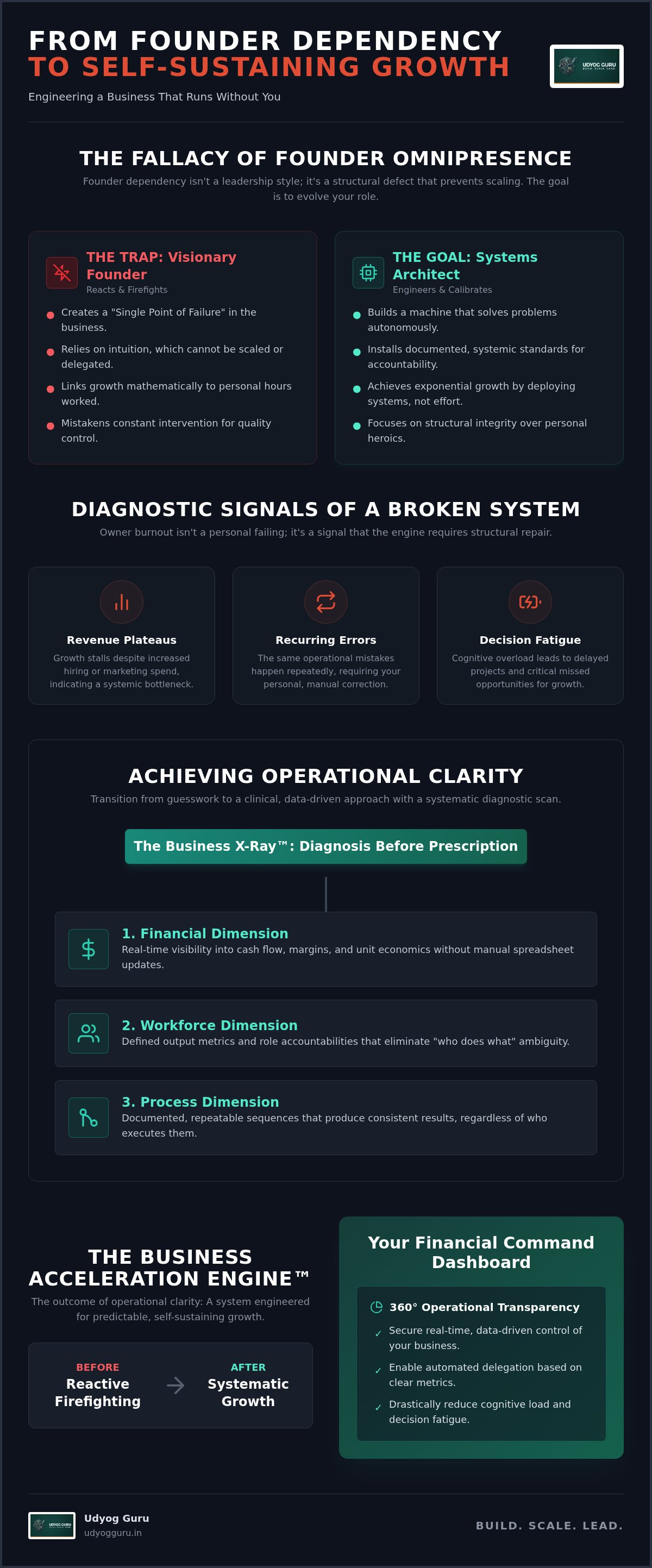
Operational friction is the inevitable byproduct of this systemic chaos. It manifests as slow response times, repetitive errors, and a team that waits for permission rather than executing protocols. To scale, you must transition from the "Visionary Founder" who solves every problem to the "Systems Architect" who engineers a machine that solves problems autonomously. This shift requires a clinical detachment from the daily firefighting and a commitment to structural integrity over personal heroics.
Myth: Founder Involvement Equals Quality Control
The belief that your personal involvement ensures quality is a dangerous fallacy. Individual brilliance is the ultimate bottleneck to enterprise growth. When quality depends on your oversight, you create a "Single Point of Failure" within the enterprise architecture. If the founder is removed for even 48 hours, the system begins to degrade. Intuition-based decisions are impossible to replicate, which prevents team accountability. Without documented, systemic standards, your staff can't meet expectations because those expectations only exist in your head. This reliance on founder magic ensures that the business remains small and fragile.
The Mathematical Limit of Personal Productivity
Growth is mathematically capped when it's linked to a single person's hours. Linear work produces linear results. To achieve exponential growth, you must shift from performing tasks to installing systems. Consider the following diagnostic signals that your current architecture has reached its limit:
- Decision fatigue that leads to delayed project timelines and missed opportunities.
- Revenue plateaus that persist despite increased hiring or marketing spend.
- Recurring operational errors that require your personal, manual correction.
Owner burnout isn't a personal failing; it's a diagnostic signal for repair. It indicates that the current engine is over-revving to compensate for missing structural components. Achieving true operational clarity for founders involves recognizing this ceiling and engineering a path beyond it through systematic delegation and automated control. You don't need to work harder; you need to calibrate the machine to work without you.
Operational Clarity as a Diagnostic Protocol: Moving Beyond Intuition
Operational clarity for founders is the precise transparency of workflows, data streams, and accountability structures. It isn't a vague sense of "knowing what's going on." It's a clinical state where every component of the enterprise is visible and measurable. In business engineering, we adhere to a "Diagnosis-Before-Prescription" protocol. Attempting to fix a scaling issue without first identifying the root cause of friction is the operational equivalent of performing surgery without an imaging scan. True operational clarity for founders requires a systematic examination of the business machine across three critical dimensions: Financial, Workforce, and Process.
- Financial Dimension: Real-time visibility into cash flow, margins, and unit economics that doesn't require manual spreadsheet updates.
- Workforce Dimension: Defined output metrics and role accountabilities that eliminate "who does what" ambiguity.
- Process Dimension: Documented, repeatable sequences that produce consistent results regardless of who is executing them.
Without these layers of transparency, management is reduced to guesswork. Initiating a comprehensive systematic scan of these pillars is the first step toward structural recovery and long-term stability.
The Business X-Ray™: Scanning for Hidden Bottlenecks
The Business X-Ray™ serves as a rigorous diagnostic scan for enterprise health. It identifies "invisible" leaks where revenue and time dissipate due to redundant workflows or misaligned resources. By utilizing quantitative auditing, we remove the emotional bias that often clouds a founder's judgment. This data-driven approach allows us to map the scalable business architecture required to survive and thrive in 2026. When you stop guessing and start measuring, you can pinpoint exactly where the engine is losing compression.
Intuition vs. Protocol-Led Management
Management by intuition is a liability that scales poorly. Gut feelings are erratic, subjective, and impossible to delegate. In contrast, protocol-led management provides the stability required for predictable growth. Data-driven transparency is the only effective cure for founder anxiety. When you have clear diagnostic reporting, your confidence isn't based on hope; it's based on verified system performance. This level of rigor also transforms stakeholder confidence. Investors and partners don't trust a founder's "vibe," but they do trust an architect who can present a clear, functioning blueprint of their operations.
Myth: Hiring More People Solves Operational Friction
Hiring "A-players" into a broken system is a common strategic error. Talent is fuel, not an engine. If the internal architecture is misaligned, adding more people simply increases the complexity of the friction. Without operational clarity for founders, new hires become additional variables to manage rather than autonomous units of production. You don't solve a structural leak by pouring more water into the tank; you solve it by repairing the pipes. Talent alone cannot compensate for a lack of systematic design.
Scaling Chaos: The Hidden Cost of Premature Hiring
Premature hiring creates "Management Debt." When workflows aren't documented, every new employee requires manual onboarding and constant oversight. Instead of offloading work, the founder becomes a "Chief Firefighter." They spend the majority of their day answering questions that should have been answered by a protocol. This accelerates failure. Chaos scales. Adding headcount to a non-systematized business doesn't scale growth; it scales the volume of the noise. It turns a manageable mess into an unmanageable disaster.
The Workforce X-Ray™ serves as a critical diagnostic tool in this phase. It allows for a clinical examination of current team outputs versus systemic requirements. By identifying where talent is being wasted on manual workarounds, we can re-engineer the role to fit the architecture. This ensures that every hire is an intentional installation rather than a reactive patch.
Workforce Optimization: Engineering High-Output Teams
Transitioning from a "people-dependent" to a "system-dependent" model is the only way to achieve sustainable scale. High-output teams aren't born; they're engineered through the Workforce Acceleration Engine™. This framework installs accountability protocols that function without founder oversight. It relies on "Automated Delegation," where the system itself triggers tasks and monitors completion based on pre-defined logic. The system manages the task, while the human executes it.
Achieving operational clarity for founders means knowing that the team is executing the blueprint correctly, even when you aren't in the room. When you install these systematic guards, you reduce the cognitive load of management. The business stops being a collection of personalities and starts being a self-correcting machine. This shift allows the founder to focus on high-level architecture rather than low-level supervision.
Engineering the Business Acceleration Engine™: From Firefighting to Systematic Growth
The Business Acceleration Engine™ isn't a strategy; it's a mechanical installation for your company. In a clinical context, "Growth" refers to a simple increase in volume or headcount, which often leads to increased friction. "Acceleration," however, is the structural increase in the rate of growth through systemic efficiency. Achieving operational clarity for founders requires this transition from manual firefighting to systematic acceleration. You don't just want a bigger business; you want a faster, more efficient machine that requires less manual input to produce higher outputs.
Installing the Growth Framework
Building a business growth framework that survives market volatility requires a rigorous 5-step protocol:
- Step 1: Diagnostic Scan. Utilizing the Business X-Ray™ to identify structural leaks and friction points.
- Step 2: Protocol Mapping. Documenting every repeatable workflow to eliminate ambiguity and decision fatigue.
- Step 3: Tech Integration. Deploying automation and AI to handle low-level cognitive tasks.
- Step 4: Systematic Calibration. Aligning the workforce with the new architecture through defined output metrics.
- Step 5: Autonomous Monitoring. Installing dashboards for real-time performance tracking and self-correction.
AI plays a pivotal role in this architecture by automating repetitive operational tasks. This isn't about replacing humans; it's about removing the human error inherent in manual data entry and task routing. By integrating AI into the core workflows, we ensure the engine runs at peak compression without constant human oversight.
Removing Founder-Dependency via Technology
The AI Tech Business Integration Bootcamp provides the technical blueprint to replace manual oversight with automated systems. This shift allows you to architect self-correcting workflows that only alert the founder during significant anomalies. Instead of supervising people, your role evolves into monitoring systems. You stop asking "Is the team working?" and start asking "Is the system performing within the defined parameters?"
This evolution is essential for true operational clarity for founders. When technology handles the "how," the founder is free to focus on the "where." You can initialize your engine upgrade by moving away from the role of a manager and embracing your position as a Systems Architect. This ensures that the business remains stable even during rapid scaling or external market shifts.
The Financial Command Dashboard: Achieving 360-Degree Operational Transparency
The Financial Command Dashboard serves as the ultimate "Control Center" for the modern Systems Architect. While traditional accounting focuses on historical data, this dashboard provides the real-time visibility required for scaling a business with clinical precision. It represents the final layer of operational clarity for founders, moving the enterprise away from reactive bank-balance monitoring toward proactive financial strategy. When you can track profitability per product, per person, and per process, you stop guessing where your margins are and start engineering them.
This transition allows for a granular understanding of the enterprise's fiscal health. Instead of looking at broad revenue categories, you're able to see exactly which workflows are producing the highest ROI and which ones are consuming resources without adequate return. It's the difference between looking at a map and having a live GPS telemetry system for your entire organization.
The Science of Fiscal Control
Monthly P&L statements are post-mortems; they tell you what has already failed. A real-time command dashboard, however, functions as a live diagnostic system for your business engine. By implementing systematic financial auditing, you can identify "Revenue Leaks" that occur when workflows are inefficient or resources are misallocated. This level of transparency is the only way to achieve true operational confidence. You don't just hope the business is profitable; you verify its performance through hard data daily.
Fiscal control isn't just about cutting costs. It's about the clinical allocation of capital to the areas of the business that demonstrate the highest efficiency. When you have 360-degree transparency, you can make bold strategic moves because they're backed by verified system performance rather than founder intuition.
Next Steps: Installing Your Operational Command Center
Your journey toward a self-sustaining enterprise architecture follows a logical, progressive sequence: Diagnostic, Acceleration, and Control. We began by using the Business X-Ray™ to identify structural defects and moved through the installation of the Business Acceleration Engine™ to remove founder dependency. The final step is the deployment of the Financial Command Dashboard to secure long-term transparency and predictable growth.
The immediate impact of achieving operational clarity for founders is a significant reduction in cognitive load. You're no longer the bottleneck; you're the architect of a machine that operates predictably without your constant intervention. This isn't a motivational shift but a mechanical one. If your business currently feels like a black box of unpredictable costs and friction, it's time to initialize a formal scan of your architecture.
Register for the Business X-Ray™ diagnostic today to begin the systematic repair of your operations and claim your freedom from the daily grind through rigorous engineering.
Transitioning from Manager to Systems Architect
Operational friction isn't an inevitable byproduct of growth; it's a diagnostic signal that your current enterprise architecture has reached its limit. Scaling a business requires a clinical departure from the "hustle" mindset, replacing it with rigorous systematic protocols. You've seen that adding headcount without structural integrity only compounds chaos. True operational clarity for founders is achieved when you stop acting as the primary engine and start acting as the architect. By installing documented workflows and automated delegation, you transform a people-dependent operation into a self-sustaining machine.
The path to sustainable freedom involves precise calibration. Our proprietary Business X-Ray™ methodology provides the imaging necessary to identify hidden bottlenecks, while the Financial Command Dashboard integration offers real-time telemetry for fiscal control. This clinical approach to SME scaling ensures your business operates with predictability and precision. It's time to stop firefighting and start engineering your exit from the daily grind. Your enterprise is a machine; it's time to give it the professional-grade engine it deserves. Secure Your Business X-Ray™ Diagnostic Scan Now and begin your structural transformation.
Frequently Asked Questions
What is the primary difference between operational clarity and general business management?
Operational clarity for founders is a structural state of transparency, whereas general management often focuses on supervising people. Management is a human-centric activity that relies on subjective oversight. Operational clarity is a system-centric architecture where workflows and data are engineered to be self-evident. It moves the focus from personal intuition to verified system performance, ensuring that the business machine operates predictably regardless of individual management styles or personality types.
How do I know if my business is ready for the Business Acceleration Engine™?
Your business is ready for the Business Acceleration Engine™ once a diagnostic scan reveals that manual effort has reached its maximum output. If revenue has plateaued despite increased hours or if you're experiencing "Management Debt" from undocumented processes, the engine must be installed. This Tier 2 intervention is designed for enterprises that have validated their market fit but are currently constrained by a fragile, founder-dependent and non-scalable operational architecture.
Can operational clarity be achieved without hiring a large management team?
Yes, operational clarity is often achieved by reducing headcount rather than increasing it. By installing automated delegation and self-correcting workflows, you replace the need for middle management. Systems implementation allows the founder to maintain control through data dashboards rather than human layers. This lean architecture ensures that high-output production is driven by the engine's design rather than an expensive administrative staff that often scales chaos rather than efficiency.
What are the common signs of founder dependency in a scaling SME?
The most prevalent signs include a total cessation of progress when the founder is offline and a team that requires permission for routine tasks. If you are the "Chief Firefighter" answering repetitive operational questions daily, your business has a structural dependency. Other diagnostic signals include unpredictable growth patterns and a lack of real-time transparency, indicating that the business machine cannot function without your constant manual calibration.
How does the AI Tech Business Integration Bootcamp help in removing operational friction?
The AI Tech Business Integration Bootcamp provides the technical protocol for replacing manual oversight with automated systems. It focuses on architecting workflows where AI handles low-level cognitive tasks, such as data routing and task triggers. This reduces the friction caused by human error and decision fatigue. By integrating these modern technologies, the business achieves a higher state of operational clarity for founders, allowing for precise, data-driven scaling without increasing management overhead.
Is the Financial Command Dashboard compatible with existing accounting software?
The Financial Command Dashboard is designed as an integration layer that sits atop your existing accounting software to provide real-time telemetry. While traditional software records historical data for compliance, this dashboard transforms that data into a strategic command center. It pulls raw figures into a structured visualization of profitability per product and process. This ensures you have 360-degree transparency without needing to replace your underlying fiscal record-keeping or compliance systems.
How long does it typically take to install a Business X-Ray™ diagnostic framework?
The installation of the Business X-Ray™ diagnostic framework is a methodical process that typically spans four to six weeks. This duration allows for a thorough scan of your financial, workforce, and process dimensions. We conduct a clinical examination of current workflows to map existing friction points before delivering a comprehensive repair blueprint. This steady, deliberate pace ensures that the final diagnostic architecture is both accurate and actionable for the systematic scaling of operations.
What happens to the founder's role once operational clarity is established?
Once operational clarity is established, the founder transitions from a manager to a Systems Architect. Your daily focus shifts from low-level supervision to high-level strategic engineering. Instead of firefighting, you monitor the Financial Command Dashboard to ensure the Business Acceleration Engine™ is performing within its defined parameters. This evolution reduces your cognitive load and provides the freedom to focus on acquisition, innovation, or high-level expansion while the machine runs autonomously.


