
Automating an unstable workflow doesn't engineer efficiency; it simply accelerates institutional dysfunction. When daily operations collapse the moment you step away, hastily deploying disconnected applications only fragments your data across isolated spreadsheets and wastes vital capital. You already recognize that your personal intervention shouldn't be the operational linchpin of the enterprise. Constructing a disciplined business automation roadmap for founders allows you to diagnose systemic drag, standardize your baseline mechanics, and systematically engineer operational autonomy without writing custom software.
In this 2026 operational guide, you'll discover how to transition your enterprise from high-friction manual oversight into a resilient, automated architecture that safeguards founder bandwidth. We will map out how to eliminate persistent workflow bottlenecks, calibrate team capacity with predictive accuracy, and secure dependable visibility into company performance without micromanaging staff. The diagnostic frameworks that follow provide the exact implementation sequence required to scale operations as a reliable, predictable system.
Key Takeaways
- Identify why ad-hoc software adoption compounds systemic friction, and learn why diagnostic process mapping must precede tool installation.
- Deploy a disciplined business automation roadmap for founders to systematically eliminate workflow bottlenecks and scale operations without writing custom code.
- Protect enterprise capital by leveraging resilient no-code ecosystems instead of incurring the technical debt and ongoing maintenance liabilities of custom software development.
- Install core operational engines across workforce management, financial reporting, and fulfillment to enforce accountability without requiring constant manual oversight.
- Transition your enterprise from founder dependency into an autonomous, scalable machine using structured diagnostic frameworks and execution engines.
The Anatomy of Founder Dependency: Why Ad-Hoc Automation Fails
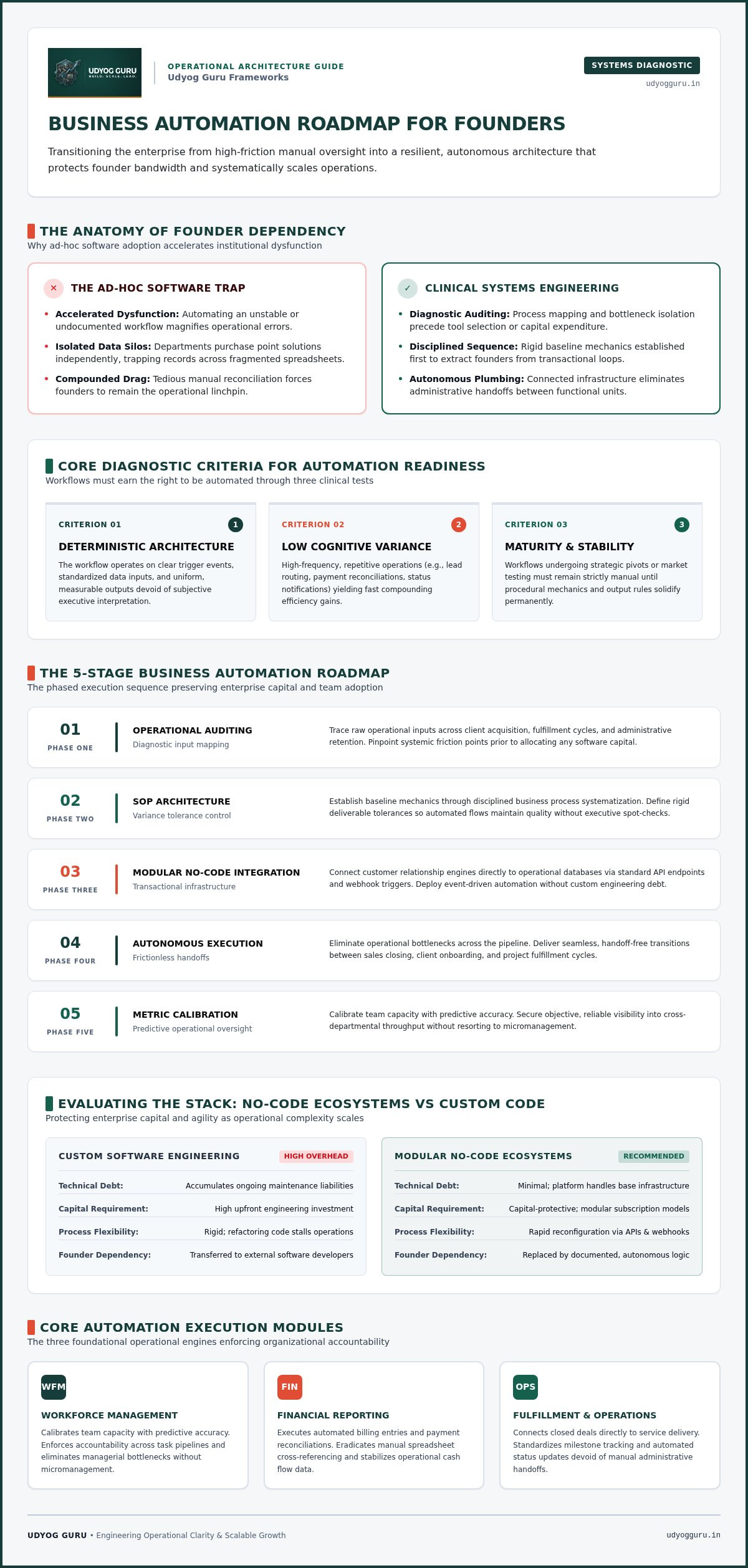
Founder dependency is rarely a failure of personal capacity; it's an architectural pathology. When daily execution requires continuous executive intervention, the business functions as an oversized sole proprietorship rather than a scalable apparatus. Many executives attempt to resolve this strain by purchasing point-solution applications on impulse. However, automating an undocumented, dysfunctional workflow simply accelerates operational errors across the organizational pipeline. Sustainable enterprise expansion demands shifting from emotional management to clinical systems engineering. A disciplined Business Process Automation (BPA) strategy defines the precise operational sequence required to audit baseline mechanics, establish rigid controls, and extract the founder from transactional loops. Installing a structured business automation roadmap for founders ensures your operational plumbing is sound before you commit capital to software.
The Trap of Premature Software Adoption
Founders often deploy automation tools to compensate for fractured delegation protocols. When departments independently acquire isolated subscriptions without an underlying system design, they create deep data silos. Customer records, billing entries, and fulfillment milestones end up trapped across incompatible spreadsheets and applications, forcing staff to conduct tedious manual data reconciliation. Before licensing new tools, leadership must isolate systemic friction by identifying operational bottlenecks in business processes through objective diagnostic auditing. Premature software adoption inflates operational overhead while multiplying the very managerial drag it was purchased to eliminate.
Core Diagnostic Criteria for Automation Readiness
Workflows must earn the right to be automated. Subjecting an erratic, fluctuating process to algorithmic automation produces compounding failures at scale. A viable business automation roadmap for founders assesses operational candidates against three diagnostic criteria:
- Deterministic Architecture: The workflow relies on clear trigger events, standardized data inputs, and uniform, measurable outputs devoid of subjective interpretation.
- Low Cognitive Variance: High-frequency, repetitive operations—such as lead routing, payment reconciliations, and status notifications—yield rapid compounding efficiency gains.
- Maturity and Stability: Unstable workflows currently undergoing strategic iteration or market testing must remain manual until procedural patterns solidify permanently.
The 5-Stage Business Automation Roadmap for Founders
Executing digital transformation without an architectural sequence burns capital. To insulate the enterprise against systemic failure, a disciplined business automation roadmap for founders enforces five rigorous stages: operational auditing, SOP architecture, modular no-code integration, autonomous execution, and metric calibration. Rather than attempting a wholesale overnight overhaul, leadership must stage deployments systematically to preserve cash flow and employee adoption.
Phase 1 & 2: Process Auditing and SOP Architecture
Operational design begins by tracing raw inputs across client acquisition, fulfillment cycles, and administrative retention. Establishing baseline mechanics through disciplined business process systematization guarantees your team resolves structural bottlenecks before licensing software. Document variance tolerances clearly; automated systems must preserve deliverable standards without requiring executive quality control checks.
Phase 3 & 4: Modular Integration and Autonomous Execution
Once procedures are documented, connect your transactional infrastructure. Link customer relationship engines to operational databases using standard API endpoints and webhook triggers. Modern enterprise tooling seamlessly handles event-driven triggers, eliminating administrative handoffs between sales closings and project onboarding. As detailed in the comprehensive AI roadmap for SMEs, this integration phase deploys intelligent routing that augments human judgment rather than attempting to replace critical strategic oversight. To safeguard operational continuity, configure automated exception notifications to alert team leads whenever an algorithmic loop encounters data anomalies or delivery exceptions.
Phase 5: Continuous Calibration via Metric Feedback Loops
Autonomous systems require scheduled telemetry checks to prevent operational drift. Founders should review error rates, execution speed, and department throughput weekly. Analyzing execution logs allows you to isolate friction points early, ensuring operations scale cleanly alongside revenue.
To calibrate your organization's readiness across these operational phases, exploring the structured frameworks at udyogguru.in provides the diagnostic baseline needed before initiating tool configuration.
Evaluating the Automation Stack: Custom Engineering vs. No-Code Ecosystems
Selecting the technical architecture for operational workflows is an irreversible strategic decision. Choosing the wrong paradigm saddles your enterprise balance sheet with perpetual maintenance liabilities and operational friction. In foundational overviews such as IBM's analysis of What is Business Automation?, systemic agility remains paramount. A viable business automation roadmap for founders rejects the instinct to commission bespoke applications from scratch. Instead, leadership must prioritize modularity, native API availability, and platform stability over brittle proprietary codebases.
Before committing capital to software, evaluate your technical selection against three core engineering criteria:
- Deployment Velocity: Configurable ecosystems reach operational deployment within days, whereas custom software lifecycles consume months of unvalidated engineering hours.
- Maintenance Drag: Standardized platforms absorb underlying security, server orchestration, and API revisions automatically, eliminating continuous developer retainers.
- Architectural Adaptability: Modular stacks allow teams to swap individual software layers as organizational needs shift, preventing structural platform lock-in.
The Hidden Vulnerabilities of Custom Software
Custom software development introduces acute operational fragility into scaling enterprises. Commissioning bespoke applications creates absolute operational dependency on outsourced developers or internal engineers, converting routine workflow updates into prolonged development cycles. Inevitable API schema updates by third-party tools routinely sever custom scripts, triggering severe operational downtime and diagnostic expenses. Founders shouldn't build proprietary software when mature, standardized tools already resolve functional mechanics with verified reliability.
Architecting a Resilient No-Code and AI Ecosystem
Modern no-code architectures bypass engineering backlogs entirely. Visual integration platforms allow operations teams to assemble, test, and deploy enterprise-grade workflows across administrative departments rapidly. Integrating modern LLM endpoints directly into these pipelines automates the ingestion of unstructured emails, vendor invoices, and support tickets, routing sanitized data into operational databases instantaneously. Within a rigorous business automation roadmap for founders, this modular approach enforces strict data governance by centralizing corporate intelligence inside secure, unified repositories. Operational autonomy accelerates when systems rely on standardized components rather than handcrafted code.
Engineering Core Automation Modules: Workforce, Finance, and Operations
Executing an effective business automation roadmap for founders requires moving past generic tooling into the clinical calibration of three core engines: workforce delegation, financial reporting, and fulfillment. When these functional tiers communicate through synchronized protocols, the enterprise operates as a predictable machine rather than a founder-dependent workshop. Isolating each department into modular, automated subsystems eliminates operational drag while establishing objective accountability across the entire balance sheet.
Automated Delegation and Workforce Accountability
Verbal check-ins and manual assignments introduce chronic managerial ambiguity. Instead, construct event-driven routing rules that parse project intake parameters and assign tasks to personnel based on predefined operational triggers. Implementing proven workforce optimization strategies embeds structural compliance directly into task environments. Executive intervention shifts entirely to exception-based governance; leadership alerts trigger only when an operational variable breaches defined performance tolerances.
Centralized Financial Command and Metric Telemetry
Manual spreadsheets obscure financial health with delayed figures. A calibrated financial engine automates client billing, bank feed reconciliations, and collection notifications on exact billing intervals. Eliminating manual bookkeeping handoffs delivers instant visibility into real-time net margins and team operational costs. In addition, these linked records forecast cash flow trajectories automatically by comparing rolling expenses against contractual recurring revenue.
Client Acquisition and Service Fulfillment Workflows
Client delivery must produce reliable outcomes independent of individual employee memory. Calibrated intake funnels evaluate inbound prospect data, route qualified leads to sales coordinators, and immediately trigger client onboarding workflows upon payment clearance. Transitioning data collection from unstructured email threads into standardized client portals prevents delivery errors and protects institutional momentum.
To inspect and calibrate these three functional engines across your enterprise, explore the structured diagnostic systems at udyogguru.in to audit your baseline architecture.
Transitioning to Autonomous Operations with Udyog Guru Frameworks
True operational freedom demands shifting the entire enterprise from founder reliance to system-driven execution. Technology alone cannot correct organizational misalignment; software simply codifies whatever operating discipline already exists. Udyog Guru provides a systematic business transformation methodology engineered for scaling enterprises. By replacing ad-hoc tool experimentation with structured, clinical protocols, founders construct an enduring business automation roadmap for founders that secures operational autonomy without bloating fixed overhead.
Diagnostic Assessment via Business X-Ray™ and Workforce X-Ray™
Operational intervention must begin with precise diagnostics. Rather than guessing where workflow leaks occur, leadership deploys the Business X-Ray™ to clinically evaluate information flow, capacity limits, and pipeline handoffs across the company. Simultaneously, the Workforce X-Ray™ isolates latent accountability gaps, structural delegation breakdowns, and employee productivity drag. Performing these rigorous assessments establishes an objective baseline of organizational health before deploying automated infrastructure.
Execution via Acceleration Engines and AI Integration Bootcamps
Once baseline diagnostics identify systemic constraints, structured execution frameworks systematically engineer autonomy. Deploying the Business Acceleration Engine™ installs predictable, systems-driven growth loops that run independently of day-to-day executive coordination. To embed modern automation protocols deep within internal operations, enterprise leadership completes the AI Tech Business Integration Bootcamp, mastering no-code integration mechanics, algorithmic routing, and autonomous triggers without writing custom code.
This systematic overhaul concludes with installing real-time operational governance. The Financial Command Dashboard consolidates transactional data feeds, operational margins, and burn rates into an executive interface, providing complete financial transparency without requiring tedious manual reconciliation. When integrated correctly, this end-to-end framework secures predictable operational capacity while returning valuable bandwidth directly to the founder.
Begin engineering your autonomous enterprise by scheduling your diagnostic scan: Audit your operations with Udyog Guru systems.
Engineering Your Autonomous Enterprise Architecture
Operational freedom isn't achieved through reactive software subscriptions; it demands rigorous systems design. A disciplined business automation roadmap for founders replaces procedural volatility with deterministic architecture, linking workforce delegation, real-time financial reporting, and client fulfillment into a synchronized engine. Auditing baseline mechanics before configuring no-code tools protects your capital and eliminates founder dependency at the structural root.
Executing this transformation requires clinical precision. Diagnostic evaluations like the Business X-Ray™ and Workforce X-Ray™ isolate latent operational friction before deployment begins. Through structured execution frameworks like the Business Acceleration Engine™, the Workforce Acceleration Engine™, and the hands-on AI Tech Business Integration Bootcamp, your leadership team installs resilient, scalable workflows that run predictably without executive micro-management. Take control of your operational trajectory: Calibrate your business systems with Udyog Guru and build an enterprise engineered to scale autonomously.
Frequently Asked Questions
What is a business automation roadmap for founders?
A business automation roadmap for founders is an architectural blueprint that defines the sequence for process documentation, operational delegation, and technology integration. Rather than purchasing disconnected software tools on impulse, this framework systematically diagnoses operational friction, standardizes workflows into rigid standard operating procedures, and deploys modular no-code infrastructure. It extracts the founder from transactional task loops, establishing predictable capacity and enterprise autonomy.
How do I know which business processes to automate first?
Target high-frequency, deterministic workflows that exhibit low cognitive variance, repetitive steps, and standardized data handoffs. Ideal initial candidates include inbound lead routing, customer invoice generation, and standardized client onboarding sequences. Conversely, workflows currently undergoing strategic iteration or requiring nuanced executive discretion should remain manual until their operational mechanics stabilize permanently. Automating an unstable process simply multiplies organizational errors across the delivery pipeline.
Is custom software development necessary to automate my business operations?
Custom software development isn't necessary to automate operations, and it frequently introduces severe technical debt into growing businesses. Modern enterprises leverage modular no-code ecosystems and standardized API integrations to build resilient systems. Bespoke software engineering demands continuous developer retainers, prolonged development cycles, and brittle maintenance schedules. Configurable platforms allow founders to assemble enterprise-grade operational engines in days without long-term programming dependencies.
How does business automation reduce founder dependency in daily management?
Business automation eliminates founder dependency by replacing manual supervisory oversight with programmatic routing rules, event-driven triggers, and exception notifications. When operational workflows follow deterministic logic, tasks transfer between team members automatically upon milestone completion. Founders don't need to conduct daily verbal status checks or reconcile spreadsheets manually. Instead, leadership governs by exception, intervening only when an automated telemetry alert detects an operational variance.
What is the difference between simple workflow automation and full operational systematization?
Simple workflow automation connects point-to-point digital tasks, whereas full operational systematization engineers an interconnected, autonomous organizational architecture. Triggering an alert when a web form is submitted represents a basic tactical integration. In contrast, true operational systematization aligns workforce delegation engines, standardized SOP protocols, real-time financial tracking, and client delivery into a unified machine, ensuring the entire enterprise functions predictably without executive intervention.
Can business automation frameworks integrate with existing legacy software tools?
Yes, structured automation frameworks connect with legacy software through standardized API endpoints, webhooks, and secure middleware engines. Enterprises don't need to decommission legacy operational databases or accounting software to achieve modern efficiency. Modular no-code middleware acts as an architectural bridge, extracting data from existing legacy systems and synchronizing records across your operational dashboards, CRM pipelines, and project delivery boards seamlessly.
How does the Business X-Ray™ assess my company's readiness for automation?
The Business X-Ray™ conducts a clinical diagnostic audit across your company's operational pipelines to isolate systemic friction and workflow variability. This diagnostic scan evaluates information flow, delegation handoffs, and resource capacity to determine whether procedures are sufficiently stabilized for automated integration. Completing this assessment ensures your business automation roadmap for founders targets verified structural constraints rather than digitizing chaotic, undocumented habits.


