
Hiring a traditional advisory consultant often treats the surface symptoms of organizational strain while leaving the root operational pathology completely untouched. When determining how to choose between Indian business consultants, the critical decision isn't about which firm delivers the most polished presentation deck, but which systems architect can engineer resilient, self-sustaining operational infrastructure.
You already recognize the grinding fatigue of perpetual founder dependency. When every operational crossroad demands your direct intervention, delegating tasks feels impossible because your organization lacks standardized, repeatable protocols. Most enterprises have wasted substantial capital on open-ended retainers and motivational life coaches that produce temporary inspiration instead of measurable operational execution.
This guide provides the clinical criteria needed to evaluate and select consulting partners through rigorous diagnostic matrices rather than advisory rhetoric. We'll examine the exact evaluation frameworks, phased diagnostic audits, and systems engineering standards required to install permanent operational architectures that eliminate firefighting across your enterprise.
Key Takeaways
- Distinguish between qualitative executive coaching and structural systems architecture to resolve chronic enterprise bottlenecks at their mechanical root cause.
- Deploy an empirical evaluation scorecard detailing how to choose between Indian business consultants using objective diagnostic instrumentation rather than qualitative pitch decks.
- Identify why open-ended advisory retainers disincentivize permanent resolution, while phased, tiered implementation models ensure definitive operational handoffs.
- Execute a three-stage clinical vetting protocol to audit proprietary delivery frameworks and filter out theoretical generalists before deploying capital.
- Understand how diagnostic baselines establish automated, founder-independent workflows across enterprise operations without relying on custom software coding.
Evaluating Indian Business Consultants: Advisory Fluff vs. Diagnostic Systems Architecture
Most corporate advisory relationships collapse under the weight of abstract recommendations. A traditional business consultant often approaches an organization through subjective interviews, producing voluminous slide presentations that describe obvious symptoms rather than resolving operational friction. When analyzing how to choose between Indian business consultants, leadership teams must separate qualitative advisory theories from clinical systems engineering. A viable transformation partner doesn't offer generic motivation; they treat an enterprise as an integrated industrial machine requiring precise mechanical calibration across every functional node.
Advice-only engagements fail because verbal directives cannot execute workflows. When chronic firefighting consumes senior leadership, issuing philosophical guidance about accountability only compounds fatigue. Modern enterprises require empirical diagnostic frameworks that map exact operational failure points, quantify workflow friction, and install repeatable protocols. Choosing between surface-level counsel and structural engineering determines whether an organization scales predictably or remains paralyzed by operational bottlenecks.
The Advisory Trap: Why Motivational Coaching Fails Growing Enterprises
Traditional advisory engagements frequently depend on open-ended hourly retainers that incentivize slow diagnosis over permanent resolution. This structure creates organizational dependency. When consultants bill for ongoing discussion, resolving issues rapidly undermines their billing model.
One-on-one executive coaching cannot replace operational systems architecture. A charismatic coach may inspire individual leaders, yet unengineered workflows still produce delivery failures, missed handoffs, and resource waste. Enterprise scale demands quantifiable process calibration rather than subjective mindset shifts. If an engagement doesn't produce codified operating standards, it leaves the enterprise vulnerable to human error.
The Systems Engineering Paradigm: Treating Business as a Calibrated Machine
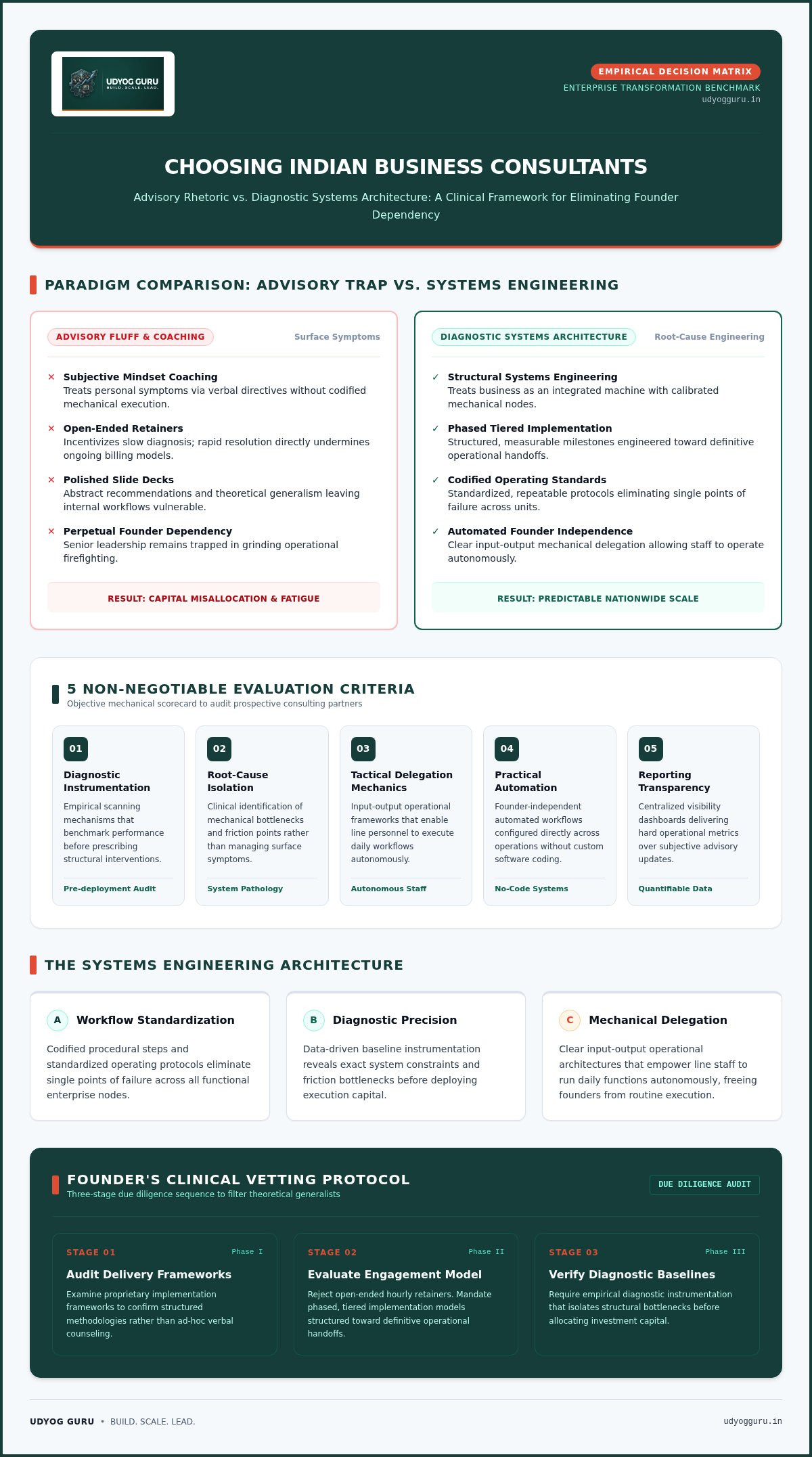
Sustainable scale requires rigorous business process systematization across core departments. When operational mechanisms function as synchronized gears, performance becomes predictable rather than erratic. Understanding how to choose between Indian business consultants means prioritizing practitioners who design structural workflows over those who deliver motivational speeches.
- Workflow standardization: Codified procedural steps eliminate single points of failure across departmental units.
- Diagnostic precision: Data-driven instrumentation reveals underlying system constraints before deploying resources.
- Mechanical delegation: Clear input-output architectures allow line staff to run daily functions autonomously.
Architecting repeatable operational machinery remains the only proven method to eliminate founder dependency permanently, allowing the enterprise to execute consistently nationwide.
Five Non-Negotiable Evaluation Criteria for Choosing a Business Transformation Partner
Subjective impressions and brand prestige fail to measure execution capacity. When evaluating how to choose between Indian business consultants, leadership teams must deploy an empirical scorecard across five mechanical variables: diagnostic instrumentation, root-cause isolation, tactical delegation mechanics, practical automation protocols, and centralized reporting transparency. Auditing candidates against these objective criteria filters out advisory generalists before capital is misallocated.
Every prospective partner must prove their capability across this evaluation matrix:
- Diagnostic instrumentation: Empirical scanning mechanisms that benchmark performance before prescribing structural interventions.
- Root-cause isolation: The technical ability to distinguish operational bottlenecks from surface-level symptoms.
- Delegation architecture: Codified workflow protocols that systematically extract founders from daily operational friction.
- Zero-code automation: System-level technical enablement that embeds modern workflows without prolonged software development cycles.
- Command center visibility: Centralized real-time dashboards that provide unambiguous executive oversight over financial and operational metrics.
Diagnostic Rigor: Moving Beyond Subjective Interviews to Empirical Audits
Prescribing solutions prior to exhaustive data capture is operational malpractice. Unstructured discovery interviews rely on human bias and selective memory. A clinical evaluation requires executing a structured business diagnostic scan to map inter-departmental dependencies, cash velocity, and throughput constraints. If a consultant proposes an operational overhaul without conducting an empirical baseline audit, their interventions will compound existing system failures.
Workflow Optimization and Delegation Architecture
Sustainable enterprise expansion hinges on codifying execution protocols. Effective transformation partners implement proven workforce optimization strategies that eliminate leadership reliance, establishing clear accountability layers across operational units. This requires mechanical process redesign rather than traditional recruitment agency services; the focus rests on engineering bulletproof workflows that average teams can run with mathematical precision.
Technological Readiness: Embedding Practical Automation Without Custom Coding
A transformation roadmap must reflect current operational standards without triggering complex technical overhead. Reviewing an ai implementation roadmap for smes reveals that true operational agility comes from connecting existing software engines, not commissioning bespoke codebases. For organizations determining how to choose between Indian business consultants, auditing whether a partner deploys zero-code automations or recommends protracted software projects is decisive. To examine how structured operational engines calibrate workflows systematically across Indian enterprises, review the frameworks at udyogguru.in.
Comparing Engagement Models: Retainer Advisory vs. Tiered Implementation Systems
Contractual structures dictate operational outcomes. When leadership teams analyze how to choose between Indian business consultants, the engagement model reveals whether an agency is invested in permanent operational independence or recurring billing. Traditional time-and-materials arrangements align financial incentives with ongoing friction. In contrast, tiered implementation models use closed-loop milestones to install durable systems, transfer operational ownership, and exit cleanly.
| Evaluation Vector | Retainer Advisory Model | Tiered Implementation System |
|---|---|---|
| Incentive Alignment | Billed hours; benefits from sustained complexity | Fixed phases; benefits from rapid installation |
| Operational Deliverable | Verbal counsel, strategy memos, slide decks | Codified workflows, deployed dashboards, internal protocols |
| Exit Criteria | Open-ended; contract cancellation required | Phase completion; measurable systems handover |
The Traditional Retainer Model: Misaligned Incentives and Recurring Overhead
Monthly advisory retainers bleed enterprise capital without securing structural assets. When consultants operate without defined implementation boundaries, engagements devolve into circular discussions and perpetual scoping exercises. The client pays for ongoing presence rather than operational engineering. If a contract defines deliverables as access to advice rather than deployed workflow architectures, it creates systemic vulnerability and advisory dependency.
The Tiered System Paradigm: Scans, Engines, and Financial Command
Modular architectures eliminate speculative risk by partitioning transformation into distinct, verifiable phases. Understanding how to choose between Indian business consultants requires demanding this staged progression:
- Phase 1: Diagnostic Scans: Isolating systemic bottlenecks and mapping workflow friction before committing execution capital.
- Phase 2: Acceleration Engines: Systematically engineering and embedding repeatable commercial workflows across key departments.
- Phase 3: Integration Bootcamps: Training internal operators to maintain automated systems without writing custom software code.
- Phase 4: Financial Command Dashboard: Installing real-time operational control units to give executive teams continuous visibility over vital metrics.
This closed-loop trajectory ensures your organization acquires permanent operational assets. Capital remains linked to tangible structural milestones rather than open-ended consulting time.
A Founder's Vetting Protocol: Step-by-Step Due Diligence Before Commissioning
Subjecting advisory candidates to rigorous clinical vetting prevents expensive operational missteps. Evaluating prospective partners requires moving beyond curated case studies and interrogating how their diagnostic machinery performs under strain. When deciding how to choose between Indian business consultants, founders should execute a three-stage audit designed to isolate genuine structural engineering from borrowed academic theory.
Phase 1: Auditing Empirical Proof and Systems Repeatability
Demand documented, reproducible operating frameworks rather than charismatic personal guidance. Prospective consultants must demonstrate precise methodologies for identifying operational bottlenecks in business using standardized protocols. Present them with a historical operational failure from your enterprise, then evaluate whether their response is intuitive speculation or a structured diagnostic algorithm that isolates root friction points.
Phase 2: Interrogating Diagnostic Instrumentation and Tooling
Inquire directly into the diagnostic instruments used to assess workforce performance and workflow throughput. Unstructured interviews and off-the-shelf surveys don't capture systemic truth. Effective partners deploy proprietary audit frameworks that quantify department-level inefficiencies and channel operational data into unified executive dashboards. If their audit mechanism lacks empirical structure, their downstream interventions will lack precision.
Phase 3: Setting Rigid Scope Boundaries and Non-Deliverables
Establish explicit contract demarcations before commissioning work. True structural transformation focuses on installing autonomous operating architectures; it doesn't include recruitment agency services, custom software coding, or open-ended executive coaching. Agreements must define milestones around system installation, workflow documentation, and team autonomy rather than calendar hours.
For leaders evaluating how to choose between Indian business consultants, executing this due diligence confirms operational competence before deploying enterprise resources. To deploy an engineering-grade audit across your enterprise, explore the diagnostic frameworks at udyogguru.in.
Architecting Sustainable Scale: Choosing Udyog Guru’s Transformation Ecosystem
Diagnostic accuracy combined with structural engineering transforms volatile commercial operations into predictable growth engines. Traditional consulting firms routinely sell subjective guidance wrapped in expensive retainer agreements. Resolving chronic enterprise bottlenecks requires replacing abstract theories with standardized, clinical installations. When analyzing how to choose between Indian business consultants, the objective standard is whether an advisory firm operates as an open-ended coaching service or delivers an integrated ecosystem of mechanical business infrastructure.
Udyog Guru delivers an engineering-grade alternative to open-ended advisory models, deploying structured transformation systems nationally across India. Rather than offering one-on-one executive coaching, custom software development, or recruitment agency services, the focus centers entirely on installing permanent, scalable operational architectures.
Deploying the Diagnostic Baseline: Business X-Ray™ and Workforce X-Ray™
Systemic transformation begins with empirical data capture rather than personal opinion. Initiating work through the Business X-Ray™ (Tier 1) establishes a multi-layer diagnostic scan of an organization's structural bottlenecks. In parallel, deploying the Workforce X-Ray™ maps functional friction, throughput velocity, and hidden capacity across operating units. Establishing this clinical baseline isolates operational pathologies before committing resources to mechanical intervention.
Systemic Implementation: Acceleration Engines and AI Integration
Once baseline diagnostics map systemic constraints, implementation proceeds through closed-loop operational engines designed for predictable scale:
- Business Acceleration Engine™: A Tier 2 implementation framework that designs and embeds standardized commercial processes across the enterprise.
- Workforce Acceleration Engine™: An operational protocol that institutes autonomous delegation systems, removing daily dependencies on senior leadership.
- AI Tech Business Integration Bootcamp: A Tier 3 intensive that embeds practical automation into routine workflows without requiring custom software coding.
- Financial Command Dashboard: A unified operational console providing real-time visibility over enterprise cash velocity and operational margins.
Every operational node connects systematically to the next. For leadership teams evaluating how to choose between Indian business consultants, this phased architecture eliminates speculative risk, minimizes founder dependency, and establishes predictable performance nationwide. Discover the complete architecture through Udyog Guru's structured transformation programs.
Calibrating Your Enterprise for Autonomous Scale
Transforming erratic operations into self-sustaining enterprise value requires replacing subjective advice with calibrated systems engineering. Mastering how to choose between Indian business consultants means rejecting open-ended retainers in favor of empirical diagnostic baselines, structured operational milestones, and quantifiable delegation architectures. Auditing prospective partners by their structural instrumentation rather than executive charisma insulates your capital from empty advisory rhetoric.
Sustainable scale happens by treating your enterprise as an integrated, synchronized machine. Through proprietary diagnostic methodologies like the Business X-Ray™ and Workforce X-Ray™, operational bottlenecks are isolated before execution begins. Deploying standardized operational engines alongside targeted AI Tech Business Integration modernizes workflows nationwide without custom software dependencies or recruitment agency overhead. Your leadership team can permanently eliminate founder firefighting and establish mathematical predictability. Initiate your enterprise transformation with Udyog Guru to install permanent operational clarity across your organization.
Frequently Asked Questions
What is the difference between an Indian business consultant and an executive coach?
An executive coach focuses on individual psychology, mindset adjustments, and leadership communication. In contrast, a structural business consultant operates as a systems architect who engineers operational workflows, delegation frameworks, and accountability machinery. While coaching addresses personal executive behavior, consulting installs structural systems that function independently of individual personalities. Understanding this distinction is essential when determining how to choose between Indian business consultants who solve operational bottlenecks rather than offering qualitative guidance.
Why do traditional advisory consulting retainers frequently fail Indian SMEs?
Traditional advisory retainers frequently fail because their commercial structure rewards billable hours rather than permanent operational resolution. When firms receive monthly retainer fees for ongoing guidance, eliminating bottlenecks quickly conflicts with their revenue model. This dynamic often results in theoretical presentations and recurring discussions without installing functional assets. Growing enterprises require closed-loop implementation systems with verifiable completion milestones that ensure permanent operational independence.
How does a Business X-Ray™ diagnostic scan identify hidden operational bottlenecks?
The Business X-Ray™ uses structured diagnostic instrumentation to execute an empirical scan across critical operational layers. Rather than relying on subjective employee interviews, it examines inter-departmental dependencies, workflow handoffs, cash velocity, and throughput constraints. This quantitative baseline isolates the root mechanical friction causing enterprise drag, preventing leadership from misallocating capital toward treating surface symptoms before the underlying system pathology is mapped.
Can business systems be modernized with AI without investing in custom software development?
Modern enterprise automation doesn't require expensive, multi-year custom software coding. Practical technological modernization connects existing enterprise platforms through proven integration protocols, API bridges, and zero-code workflow automations. Specialized frameworks, such as the AI Tech Business Integration Bootcamp, embed automated intelligence directly into routine administrative and commercial processes, allowing organizations to achieve high operational velocity without maintaining dedicated software engineering departments.
How do I ensure hiring a business consultant will not make my operations permanently dependent on them?
Insist on closed-loop implementation agreements defined by clear operational handoffs rather than ongoing advisory retainers. When evaluating how to choose between Indian business consultants, verify that engagements include codified process documentation, automated dashboards, and internal team training protocols. True systems architects work toward complete obsolescence; they build repeatable operating engines that your internal team can operate, maintain, and scale autonomously after the implementation phase ends.
What key metrics must be tracked in a real-time Financial Command Dashboard?
A Financial Command Dashboard tracks core operational vitals in a single consolidated console. Critical metrics include real-time cash velocity, gross operational margin per business unit, customer acquisition cost relative to throughput, and working capital cycle durations. Consolidating these operational variables into an automated reporting engine gives executive leadership continuous, data-backed visibility, eliminating the need to parse fragmented spreadsheets to identify fiscal leaks.


