

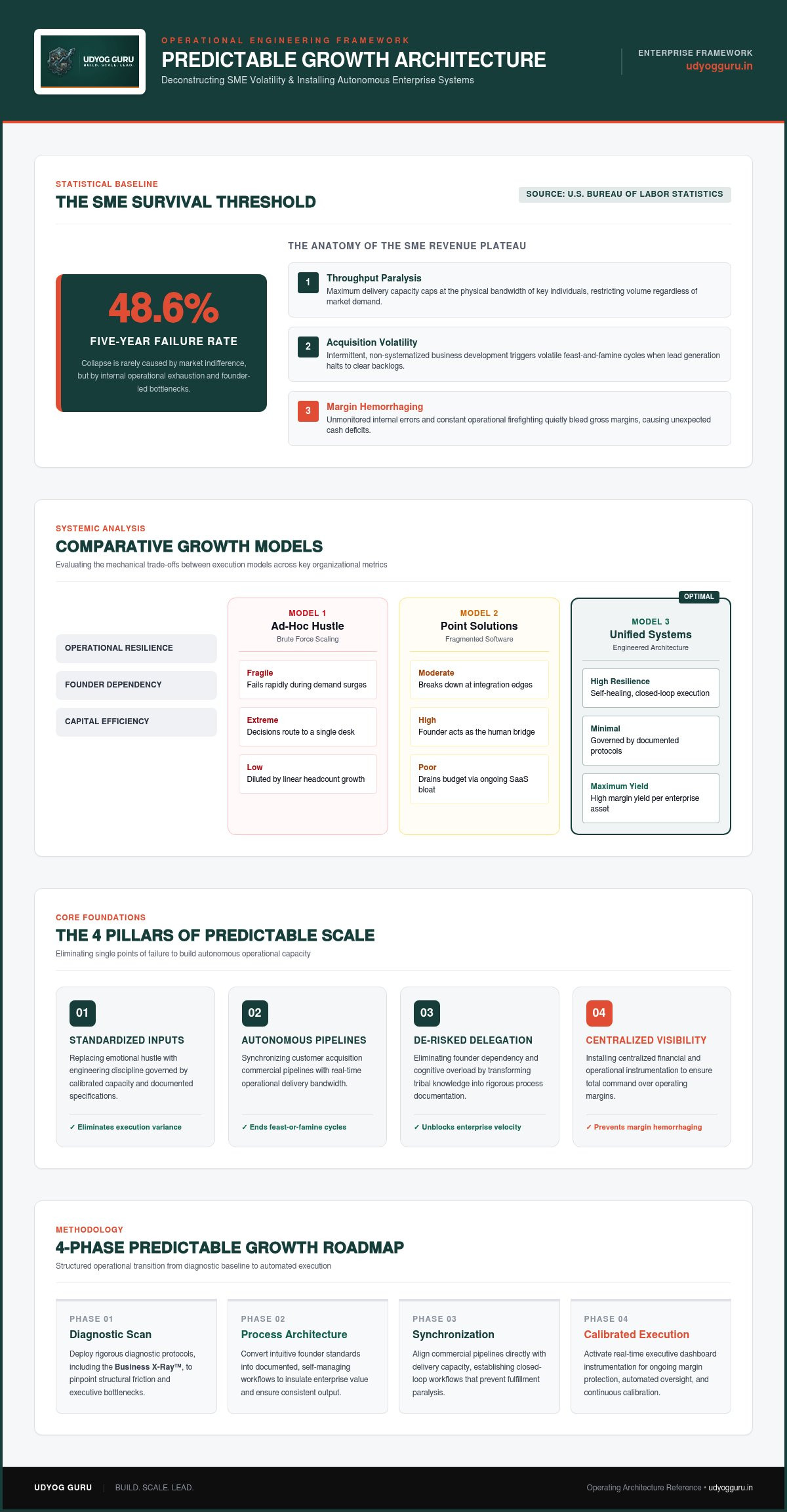
According to longitudinal data from the U.S. Bureau of Labor Statistics, 48.6% of small and medium enterprises collapse within five years; a systemic failure rarely caused by market indifference, but by internal operational exhaustion. Relying on founder-led heroics isn't a scalable business model. When sales cycles swing erratically and daily execution bottlenecks squarely at your desk, installing engineered, predictable growth strategies for SMEs shifts from a distant aspiration to an urgent operational requirement.
You already recognize that disjointed team execution, uncalibrated delegation, and opaque cash flow visibility actively bleed your enterprise's operating margins. You don't need generic business coaching or theoretical cheerleading; you need structured mechanical repair. In this guide, you'll discover the clinical frameworks and operational systems required to transition your business from volatile founder dependency to sustainable scale. We will walk through the exact blueprint to engineer self-managing operational workflows, construct autonomous revenue pipelines, and deploy centralized instrumentation for clear financial command.
Key Takeaways
- Reframe business scaling from emotional hustle into an engineering discipline governed by standardized inputs, repeatable workflows, and objective metrics.
- Compare the hidden operational drag of fragmented point solutions against unified predictable growth strategies for SMEs designed to maximize capital efficiency.
- Identify the four core operational pillars required to eliminate single points of failure and systematically de-risk your business from founder dependency.
- Execute a structured, four-phase rollout methodology that shifts your organization from baseline diagnostic scanning to calibrated, automated operational execution.
- Deploy rigorous diagnostic protocols, including the Business X-Ray™, to pinpoint structural friction and establish real-time executive visibility over operational capacity.
Deconstructing Growth Volatility: Why SMEs Fail Without Systemic Architecture
Predictable growth is not a byproduct of motivational hustle or sporadic sales pushes. Mathematically, it operates as an exact function of standardized inputs, calibrated capacity, and repeatable execution workflows. Many enterprise leaders falsely conflate top-line revenue surges with structural expansion. When customer acquisition accelerates without a synchronized delivery mechanism, operational friction compounds exponentially. Fulfillment cycles lengthen, delivery defects multiply, and client churn erodes profitability. Executing viable predictable growth strategies for SMEs requires the systematic alignment of commercial pipelines with operational capacity, grounding operational design in proven enterprise architecture principles before deploying complex software or external capital.
The Anatomy of the SME Revenue Plateau
Every expanding enterprise encounters an operational ceiling where manual oversight ceases to scale. This plateau stems from three mechanical points of failure:
- Throughput Paralysis: Maximum organizational capacity caps at the physical bandwidth of key individuals, restricting delivery volume regardless of market demand.
- Acquisition Volatility: Intermittent, non-systematized business development triggers volatile feast-and-famine cycles. Teams halt lead generation entirely to clear fulfillment backlogs, creating revenue droughts weeks later.
- Margin Hemorrhaging: Unmonitored internal errors and constant operational firefighting quietly consume gross margins, turning record sales months into unexpected cash-flow deficits.
The Fallacy of the Hero Founder Model
Relying on executive intervention to rescue stalled projects is an architectural flaw, not a leadership virtue. When operational decisions, client escalations, and technical approvals route exclusively through the founder's desk, executive cognitive overload becomes the ultimate bottleneck to enterprise velocity. This vulnerability is rarely a personnel issue; it's an information storage defect.
Tribal knowledge trapped inside the founder's head prevents effective delegation. When execution standards are intuitive rather than documented, new hires produce uneven output, prompting leadership to claw back tasks out of operational frustration. Rigorous process documentation is not administrative overhead. It's the primary engineering prerequisite that stabilizes service delivery, insulates enterprise value, and transforms erratic operations into scalable machines.
Evaluating Growth Models: Ad-Hoc Hustle vs. Point Solutions vs. Unified Systems
Most enterprises attempt expansion through brute force or ad-hoc software adoption rather than structured operational engineering. An authoritative World Economic Forum study on SME future readiness highlights that sustainable scaling relies on developing institutionalized capability architectures rather than short-term tactical adaptations. When organizations assess predictable growth strategies for SMEs, they must objectively weigh the systemic tradeoffs between manual labor, disconnected software applications, and unified operating architectures across three primary dimensions.
| Evaluation Metric | Model 1: Ad-Hoc Hustle | Model 2: Point Solutions | Model 3: Unified Systems |
|---|---|---|---|
| Operational Resilience | Fragile; fails during demand surges | Moderate; breaks at integration edges | High; self-healing, closed-loop execution |
| Founder Dependency | Extreme; decisions route to one desk | High; founder acts as the human bridge | Minimal; governed by documented protocols |
| Capital Efficiency | Low; diluted by linear headcount growth | Poor; drains budget via SaaS bloat | Maximum; high margin yield per asset |
Model 1: Ad-Hoc Hustle and Brute Force Scaling
Hustle scaling depends entirely on individual stamina. When pipeline volume rises, leadership hires uncalibrated headcount to handle the strain. This approach invariably destabilizes output quality. Without documented execution mechanics, customer churn escalates because no two team members deliver work the same way, generating extreme cash-flow variance.
Model 2: Disconnected Point Solutions and Tool Accumulation
To avoid hiring, managers often buy disconnected point solutions. They deploy separate tools for pipeline tracking, project management, and billing without an underlying schema. According to the SyncGTM 2026 RevOps Report, 67% of revenue operations leaders now run initiatives to cut tool counts because fragmentation causes severe drag. Manual duplicate entry drains team productivity, while subscription sprawl creates financial overhead without moving net delivery capacity.
Model 3: Unified Business Operating Architecture
A unified operating architecture connects operational delivery, workforce delegation, and financial controls into a single operating engine. Disjointed departments are replaced with automated, stage-gated pipelines where lead generation, service delivery, and margin collection communicate seamlessly. For an in-depth breakdown of systemic mechanics, examine our structural analysis on scaling a business. Leaders looking to systematically eliminate single points of failure across their operational core can explore the architectural frameworks built by Udyog Guru.
The 4 Structural Pillars of Predictable SME Growth
Sustainable scaling requires an integrated organizational architecture rather than fragmented point upgrades. While many advisory models treat sales acceleration, staffing, or financial accounting as isolated operational silos, durable expansion demands complete cross-functional alignment. According to the SBA guide to scaling a business, transitioning beyond early-stage viability demands structured capacity planning and institutional controls. Installing robust predictable growth strategies for SMEs requires four non-negotiable operational pillars working in mechanical tandem.
Pillar 1: Deep Operational Diagnostics
Premature software deployment or aggressive ad spend amplifies existing operational cracks. Before allocating capital, leaders must run a rigorous business diagnostic scan to pinpoint hidden friction points, capacity ceilings, and throughput traps. Systematic diagnostic scans reveal exactly where handoffs fail and why operational margins compress under volume pressure.
Pillar 2: Engineered Workforce Optimization
Relying on subjective appraisals fails to produce dependable operational output. Enterprise leaders must replace ambiguity with objective capacity mapping and mechanical delegation frameworks. Implementing calibrated workforce optimization strategies ensures clear task ownership, turning workforce productivity into an accountable, predictable science rather than a cultural hope.
Pillar 3: Modern Tech and AI Workflow Integration
Modernization does not require expensive custom software development. Instead, companies can integrate accessible off-the-shelf tools and autonomous agentic workflows to eliminate administrative overhead. Following a structured AI roadmap for SMEs allows teams to safely automate pipeline routing, client onboarding, and lead enrichment while remaining aligned with international regulatory frameworks like the EU AI Act's Article 50 transparency requirements.
Pillar 4: Centralized Financial Command Systems
Historical accounting records explain past failures, but they don't steer future trajectory. A robust financial command center delivers forward-looking operational metrics: real-time contribution margins, customer acquisition cost payback periods, and rolling cash runway. In September 2026, the Federal Reserve raised benchmark interest rates by 25 basis points; with borrowing costs elevated, capital efficiency is critical. Real-time margin intelligence protects your enterprise against the cash shortfalls that trigger 82% of SME insolvencies.
Executing the Predictable Growth Roadmap: From Audit to Calibration
Transforming an erratic enterprise into an automated, scalable operation is an engineering challenge with a distinct sequence. Skipping foundational steps to immediately chase software automation creates brittle systems that fail under stress. Executing viable predictable growth strategies for SMEs requires a systematic, four-phase rollout methodology that diagnoses structural failure points, standardizes operational delivery, automates manual handoffs, and installs centralized dashboard telemetry.
Phase 1 & 2: Diagnostic Baseline and Process Standardization
Implementation starts with an objective baseline scan rather than speculative process mapping. During Phase 1, operational architects trace every customer interaction and project deliverable through the business, isolating each hidden decision bottleneck routed through the founder. Uncovering these dependencies reveals exactly why throughput stalls whenever order volume climbs.
Phase 2 translates this diagnostic intelligence into standardized operating protocols. Key tasks are stripped of tribal nuance and documented as mechanical, sequential workflows:
- Stage-Gated Intake: Standardize client inputs at the point of sale to prevent downstream delivery scope creep.
- Deterministic Delegation: Establish unambiguous delegation thresholds that transfer decision-making authority from the founder to department leads.
- Error-Trapping Protocols: Embed quality-control checkpoints directly into delivery steps to contain defects before final completion.
Phase 3 & 4: Automation Deployment and Dashboard Governance
Once baseline operations run predictably on documented protocols, Phase 3 integrates automation to compound team throughput. Repetitive administrative duties, lead enrichment, invoice generation, and routine pipeline routing are delegated to autonomous agents and connected platforms. This phase eliminates manual human data entry across functional seams, drastically shortening operational cycle times.
Phase 4 solidifies operational control through centralized executive governance. Disjointed operational milestones and cash-flow data are piped directly into unified reporting panels. Instead of waiting for month-end accounting reconciliations, leadership reviews real-time operational capacity, working capital burn, and delivery velocity weekly to calibrate resources instantly. If you are ready to transition your organization away from volatile founder intervention, deploy engineered execution systems across your business with Udyog Guru.
Installing the Growth Engine: Structural Frameworks for Modern Enterprises
Temporary consulting interventions and unstructured business coaching rarely solve enterprise instability. Motivational advice treats symptoms rather than mechanical defects, leaving internal bottlenecks untouched once advisory engagements conclude. Durable enterprise transformation requires deploying engineered operational assets directly into the business. Choosing structural implementation engines over theoretical advice ensures predictable growth strategies for SMEs yield permanent, compounding enterprise value rather than short-lived performance surges.
The Diagnostic and Implementation Framework
Systematic business transformation relies on a structured, tiered progression. The process begins with the Business X-Ray™, a comprehensive Tier 1 diagnostic protocol engineered to scan the entire operational anatomy, isolate structural leakages, and identify hidden fulfillment limits. Once baseline vulnerabilities are mapped, organizations install the Business Acceleration Engine™ (Tier 2). This framework systematically recalibrates commercial pipelines, aligning lead intake directly with production capacity.
Workforce friction is resolved through identical mechanical rigor. The Workforce X-Ray™ conducts deep capacity audits across departments, replacing arbitrary job descriptions with objective responsibility matrices. These findings feed directly into the Workforce Acceleration Engine™, which establishes standardized delegation thresholds and governance protocols. This shifts team operations from personality-driven management to self-regulating operational throughput.
Technology Integration and Financial Control
Modernizing enterprise workflows requires operational clarity rather than custom software development. Through the specialized Tier 3 AI Tech Business Integration Bootcamp, enterprises integrate accessible automation tools directly into their operating environment. This program trains teams to deploy compliant, autonomous workflows across administrative tracking, client communication handoffs, and lead qualification, removing administrative drag while preserving operational compliance.
Permanent governance culminates in the Financial Command Dashboard. This centralized instrument panel bridges commercial pipeline velocity and back-office financial reality, providing real-time executive visibility over contribution margins, cash runway, and operational capacity. Enterprises across India deploy these structured diagnostics and implementation engines via Udyog Guru to eliminate founder bottlenecks, insulate margins, and build scalable, self-managing organizations.
Architecting Your Enterprise for Scalable Operational Certainty
Enterprise scalability isn't achieved through unmeasured hustle or disconnected SaaS adoption; it's an engineering discipline governed by standardized workflows and calibrated capacity. Moving from volatile founder dependency to reliable throughput requires diagnosing dormant bottlenecks, standardizing execution handoffs, and anchoring executive decisions in unified financial telemetry. By executing structured predictable growth strategies for SMEs, you replace chronic operational firefighting with a resilient, self-governing business engine.
Through proprietary diagnostic protocols like the Business X-Ray™ and Workforce X-Ray™, leadership pinpoints structural friction across operations and team capacity. Deploying the Business Acceleration Engine™ stabilizes delivery pipelines, while the centralized Financial Command Dashboard provides continuous instrument visibility across cash runway and contribution margins. The transition to enterprise maturity is an engineered, solvable science. Take definitive control of your operational trajectory and install predictable growth systems with Udyog Guru to scale with confidence.
Frequently Asked Questions
What makes growth predictable for an SME rather than accidental?
Growth becomes predictable when enterprise revenue and delivery are tied to standardized inputs and documented workflows rather than founder heroics. Accidental growth relies on irregular market spikes, personal relationships, and intuitive firefighting. Predictable growth operates as a closed mathematical system where specific marketing volume, conversion stages, and delivery bandwidth yield dependable output. Adopting engineered predictable growth strategies for SMEs transforms commercial operations into calibrated, repeatable machinery.
How long does it take to implement a predictable growth operating system?
Full operational implementation typically spans several structured phases across three to six months. Initial diagnostic scanning, such as the Business X-Ray™, isolates hidden friction points within weeks. Subsequent installation of standardized delivery workflows and automated delegation protocols requires progressive deployment. Speed depends on organizational complexity, but treating transformation as a sequential installation rather than an overnight overhaul prevents operational disruption while securing sustainable stability.
Can an SME achieve predictable growth without hiring expensive executive management?
Yes, an enterprise doesn't need costly executive hires to achieve operational stability. Most scaling hurdles stem from architectural deficits rather than leadership shortages. By installing documented delegation frameworks like the Workforce Acceleration Engine™ and leveraging telemetry via the Financial Command Dashboard, existing team leads can execute complex workflows autonomously. Systems architecture replaces the need for high-overhead managerial policing with objective, self-governing protocols.
Why do standard business development efforts fail to create predictable revenue?
Standard business development fails because it operates in isolated, erratic bursts. When fulfillment becomes backlogged, teams pause prospecting to manage client delivery, creating downstream pipeline droughts. Without stage-gated conversion protocols and continuous pipeline mechanics, revenue fluctuates wildly. Predictable growth strategies for SMEs eliminate this feast-or-famine cycle by separating customer acquisition from delivery bandwidth, ensuring steady lead intake regardless of internal delivery pressures.
How does an operational diagnostic scan differ from a standard financial audit?
A standard financial audit inspects historical ledger compliance, telling you what money was lost or made in past cycles. An operational diagnostic scan, such as the Business X-Ray™, functions as a mechanical examination of your active workflows. It maps process throughput, pinpoints founder decision bottlenecks, and tests operational capacity limits. While financial audits report historical symptoms, diagnostic scans identify the structural causes driving margin erosion in real time.
What role does AI integration play in stabilizing SME business workflows?
Practical AI integration automates high-frequency, repetitive tasks across intake, lead qualification, and customer reporting without requiring custom software development. Through programs like the AI Tech Business Integration Bootcamp, enterprises embed accessible agentic automations into existing operations. This systematic automation eliminates human data re-entry, accelerates pipeline velocity, and frees your workforce to focus on complex delivery without inflating administrative overhead or payroll costs.
What happens if an SME scales sales before stabilizing internal operations?
Accelerating commercial sales before stabilizing operational infrastructure leads to structural margin collapse. Influxes of new accounts quickly overwhelm undocumented workflows, creating delivery bottlenecks and missed deadlines. As fulfillment defects rise, client churn escalates and internal teams burn out from continuous firefighting. Brute-force scaling without calibrated operational capacity multiplies overhead costs, turning top-line revenue growth into dangerous net operating losses.


