
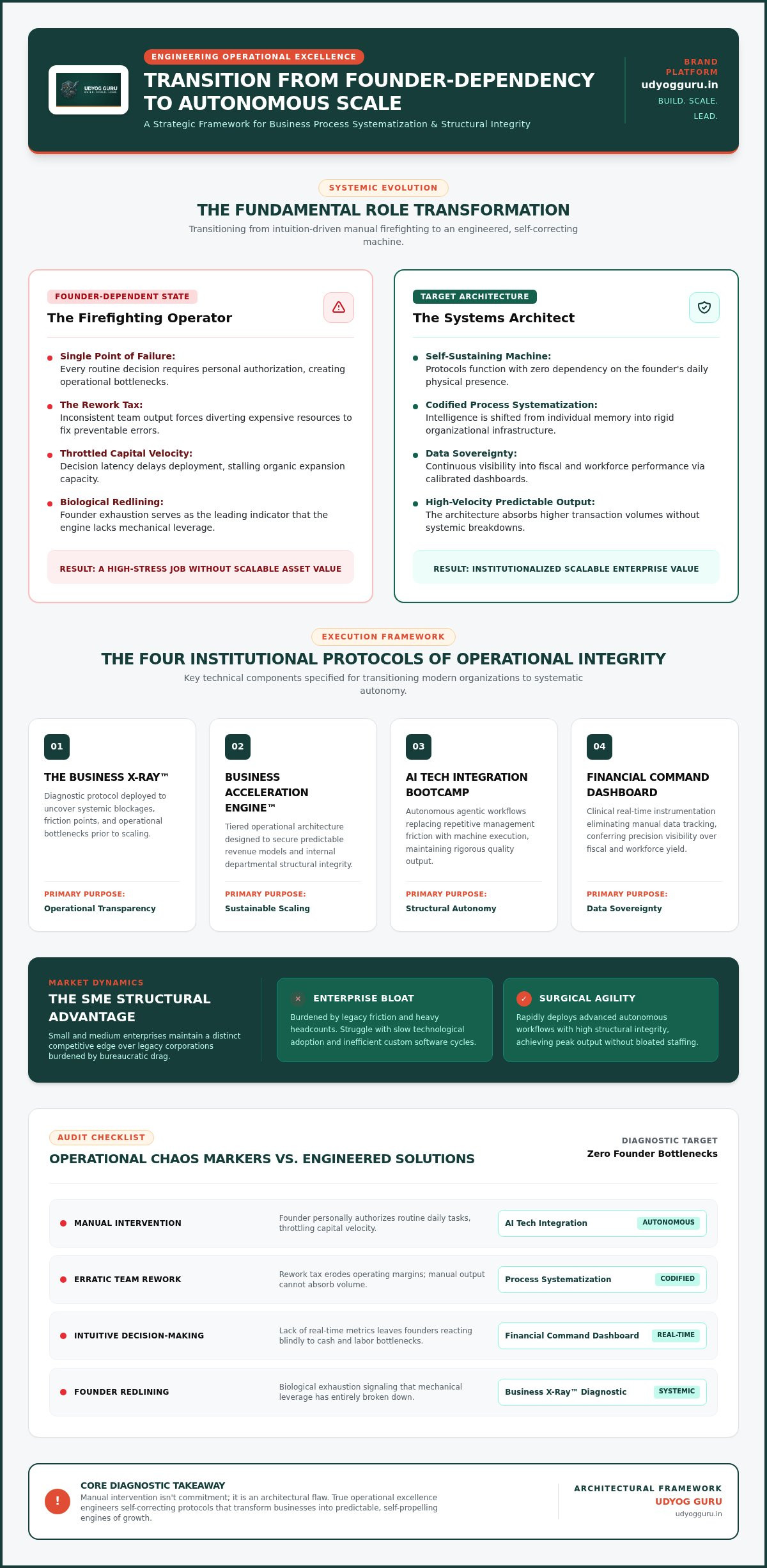
Your presence in the daily operations of your business isn't a sign of commitment; it's a symptom of structural failure. Most founders accept chronic burnout as the inevitable tax on growth, assuming that manual intervention is the only way to maintain quality across their teams. You've likely felt the exhaustion of being the single point of failure where every critical decision requires your personal authorization to move forward.
Achieving true operational excellence for entrepreneurs requires a shift from founder-dependent firefighting to the engineering of a self-sustaining machine. This article provides the technical blueprint to transition your organization into a systematic, diagnostic-driven entity that scales through rigorous architectural protocols rather than raw effort. You'll learn to replace intuition with structural integrity, ensuring your business functions as a predictable engine of growth.
We'll analyze the installation of the Business X-Ray™ to identify operational blockages and explore how the Financial Command Dashboard provides the real-time visibility necessary for precise calibration. We'll also examine how the AI Tech Business Integration Bootcamp allows you to automate repetitive management tasks, finally securing the structural autonomy your business requires to thrive in 2026.
Key Takeaways
- Diagnose systemic failures by deploying the Business X-Ray™ to scan for operational bottlenecks that impede scaling.
- Transition from founder-dependent management to a self-sustaining machine by applying the protocols of operational excellence for entrepreneurs.
- Integrate agentic AI workflows to replace manual oversight with autonomous systems that maintain high-quality output.
- Install the Business Acceleration Engine™ to establish a tiered framework for predictable revenue and departmental structural integrity.
- Achieve data sovereignty through the Financial Command Dashboard, replacing manual tracking with real-time visibility into fiscal and workforce performance.
The 2026 Crisis of Founder-Dependency: Diagnosing Systemic Failure
The Firefighting Cycle is not a badge of honor for the dedicated founder; it's a diagnostic marker of systemic failure. In the 2026 economy, manual management models are mathematically incapable of scaling because the complexity of global digital ecosystems exceeds the cognitive bandwidth of any single individual. When your business relies on your personal intervention to resolve daily friction, it lacks the structural integrity required for expansion. Achieving true operational excellence for entrepreneurs necessitates a psychological transition from the role of "Operator" to that of "Systems Architect." This shift moves the focus from individual effort to the installation of self-correcting protocols that function independently of your physical presence.
Traditional operational excellence frameworks often emphasize manufacturing efficiency, but for the modern entrepreneur, the crisis is one of decision-making sovereignty. Every time you must personally authorize a routine task, the organization pays a hidden tax in the form of delayed capital velocity and reduced workforce autonomy. These owner-dependent decision-making protocols act as a throttle on the business engine, preventing it from reaching its theoretical output capacity.
The Symptoms of Operational Chaos
Operational chaos manifests through specific, measurable failures in the business architecture. Inconsistent team output creates a "rework tax" that erodes profitability, as expensive resources are diverted to fix errors that should've been prevented by established protocols. You'll observe that despite increased marketing spend, growth remains erratic because the internal infrastructure cannot absorb new volume without breaking. Founder exhaustion serves as the final leading indicator. It's the biological signal that your business engine is redlining due to a lack of mechanical leverage and systematic design.
From Self-Employed to System-Driven
Most founders don't own a scalable asset; they own a high-stress job where they're the primary technician. To transform this liability into a functioning machine, you must replace intuition-based management with data-driven architectural standards. This requires a formal mandate for business process systematization. By codifying every workflow, you move the intelligence from your mind into the organization's infrastructure. This transition ensures that operational excellence for entrepreneurs isn't a temporary state of high effort, but a permanent structural feature of the company. It's the difference between manually pushing a stalled vehicle and engineering a self-propelling engine.
The Evolution of Operational Excellence: Beyond Lean to AI-Integrated Architecture
Operational excellence for entrepreneurs is no longer defined by the mere reduction of waste. In 2026, it represents the clinical installation of self-correcting protocols that ensure high-velocity output without manual intervention. While traditional Lean methodologies focused on trimming excess, the modern Systems Architect recognizes that Lean alone is insufficient in an era of rapid technological disruption. You need a structural "Acceleration Engine" that doesn't just eliminate waste but actively drives growth through autonomous systems. This evolution is about institutionalizing management systems so the business operates with a logic that's independent of any single human leader.
Small and medium enterprises (SMEs) possess a distinct competitive advantage here. Unlike large corporations burdened by "Enterprise Bloat," SMEs can implement agile, high-tech systems with surgical precision. This agility allows for the rapid deployment of advanced workflows that larger firms struggle to adopt due to legacy friction. By focusing on structural integrity rather than headcount, you can build a lean, high-output organization that outperforms much larger competitors.
The Architecture of Modern Efficiency
Modern efficiency isn't built on expensive custom software development. It's engineered by integrating existing AI capabilities into the core operational layer. This shift moves the burden of accountability from human-led supervision to system-led verification. Within this framework, standard operating procedures for SMEs act as the foundational code for your business machine. They define the parameters of success and allow the system to flag deviations before they become critical failures. If you're ready to upgrade your business's internal logic, exploring the Business Acceleration Engine™ can provide the necessary structural blueprint.
Agentic Workflows and Automated Delegation
The introduction of "Agentic Workflows" marks the transition from simple automation to true autonomous management. AI agents now possess the capability to handle repetitive management tasks, such as resource allocation and quality checks, which previously required founder oversight. By deploying these agents, you significantly reduce the "Coordination Tax," which is the time and capital lost during departmental handoffs. The ultimate goal is the "Autonomous SME" model, where the business functions as a self-regulating organism. This architecture ensures that operational excellence for entrepreneurs is maintained through algorithmic precision, allowing you to focus on high-level strategic engineering rather than tactical micromanagement.
The Diagnostic Protocol: Utilizing the Business X-Ray™ for Transparency
Before any structural repair can begin, a clinical examination of the organization's current state is mandatory. Most founders operate in a state of perpetual visibility deficit, relying on anecdotal feedback rather than empirical data. To achieve operational excellence for entrepreneurs, you must deploy the Business X-Ray™, a proprietary diagnostic framework designed to expose the hidden fractures in your company’s architecture. This process aligns with next-generation operational excellence by integrating advanced auditing with structural design, ensuring that any attempt to scale is built on a foundation of verified structural integrity.
Scanning the Operational Anatomy
The primary objective of an operational scan is to identify "Founder Bottlenecks" within the approval and decision-making chain. These are the points where value creation stalls because the system requires your personal cognitive input to proceed. By mapping the flow of information against the flow of actual value, we can pinpoint specific operational bottlenecks in business that leak capital and time. This diagnostic phase focuses on three critical layers:
- Protocol Verification: Determining if existing workflows are being followed or if they're being bypassed by "shadow processes."
- Decision Latency: Measuring the time elapsed between a problem arising and its final resolution.
- Resource Misalignment: Identifying where high-value talent is being utilized for low-leverage administrative tasks.
The Workforce Audit Protocol
Scaling requires a shift from subjective "time-tracking" to objective "output-quantification." The Workforce X-Ray™ provides a granular view of team performance by auditing the structural efficiency of every role. Instead of monitoring activity, this protocol installs automated accountability loops that measure the specific value produced by each team member, whether remote or on-site. This data-driven approach removes the emotional friction of management, allowing for meritocratic team optimization. It ensures that every component of your workforce engine is calibrated for maximum output, creating a predictable environment where operational excellence for entrepreneurs becomes the baseline rather than a goal. By quantifying performance, you establish the transparency needed to delegate authority without sacrificing quality.
Engineering the Business Acceleration Engine™ for Sustainable Scaling
Scaling is frequently misidentified as a marketing challenge, yet for the seasoned strategist, it's fundamentally an engineering problem. To achieve operational excellence for entrepreneurs, you must move beyond tactical growth and install a Business Acceleration Engine™. This proprietary tiered framework is designed to drive predictable revenue by ensuring the organization's structural capacity outpaces its market demand. Unlike traditional management models that break under pressure, this engine treats growth as a mechanical output of a well-calibrated machine. The installation follows a rigorous four-stage sequence:
- Step 1: Protocol Installation—Defining the departmental rules of engagement to ensure every workflow is documented and repeatable.
- Step 2: Workforce Calibration—Auditing and optimizing the team to ensure they possess the technical proficiency to execute the established protocols.
- Step 3: Tech Integration—Embedding agentic AI and automation to handle the operational heavy lifting that previously required manual oversight.
- Step 4: Continuous Optimization—Establishing rigorous feedback loops and data audits to ensure the system remains calibrated as volume increases.
Architecting for Scalability
True scalability allows an organization to absorb a 10x increase in transaction volume without a corresponding 10x increase in headcount or founder intervention. This is achieved through the installation of system-driven autonomy, where the architecture itself manages daily operational friction. By prioritizing the protocols for managing business without being there, you transform the company from a fragile, owner-centric entity into a resilient, autonomous asset. Scaling then becomes a predictable mechanical process rather than an unpredictable marketing miracle.
The AI Tech Business Integration Protocol
The integration of advanced technology begins with a clinical audit of existing workflows to identify high-leverage AI opportunities. Instead of pursuing expensive custom software development, we focus on installing no-code automation bridges that link legacy systems into a unified, intelligent ecosystem. This foundational work prepares your organization for the Tier 3 AI Tech Business Integration Bootcamp, where management tasks are shifted from human supervisors to autonomous agents. By automating the repetitive coordination layer, you secure the structural integrity needed for aggressive expansion. If you're prepared to upgrade your business's internal logic, you can begin the installation of the Business Acceleration Engine™ to secure your growth trajectory.
Data-Driven Sovereignty: The Financial Command Dashboard
Spreadsheets represent the manual transmission of a legacy business model. They require constant human intervention to update, reconcile, and interpret, which introduces a high margin for diagnostic error. To achieve operational excellence for entrepreneurs, you must transition to an automated fiscal architecture. The Financial Command Dashboard serves as the central nervous system of your organization, consolidating fiscal, workforce, and growth metrics into a single, high-fidelity view. This installation replaces fragmented data with total transparency, allowing you to move from reactive accounting to proactive engineering.
Establishing rigorous Fiscal Control Systems ensures that every operational adjustment is calibrated for maximum profitability. Without this level of visibility, scaling becomes a hazardous process of guesswork. The dashboard provides the "15-Minute CEO" state, where you can assess the structural health of the entire enterprise in minutes rather than days. It eliminates the delay between a market shift and your strategic response, securing your position as a Systems Architect who leads through data rather than intuition.
The Founders Command Centre
The health of your Business Acceleration Engine™ is determined by five critical metrics: capital velocity, acquisition efficiency, workforce output, protocol compliance, and net margin stability. Automating the flow of this data from the operational layer directly to your report removes "Reporting Friction," which is the primary cause of decision-making latency. When the system handles the data collection, the founder is freed to focus on high-level calibration. This structural sovereignty ensures that your growth is not just fast, but fundamentally sound and consistently profitable.
Final Implementation: The Bootcamp Protocol
The transition from "System Awareness" to "System Installation" is the final phase of the diagnostic journey. Modernizing your operations for the 2026 economy requires the specialized technical knowledge provided in the AI Tech Business Integration Bootcamp. This Tier 3 program is designed to help you embed autonomous agents and agentic workflows into your existing architecture, effectively shifting the burden of management from humans to machines. It's the definitive step in removing founder-dependency and securing long-term structural autonomy.
The path to operational excellence for entrepreneurs begins with a clinical assessment of your current state. By conducting a comprehensive Business Diagnostic Scan, you identify the specific fractures and bottlenecks that currently throttle your growth. Once these flaws are diagnosed, the installation of the Financial Command Dashboard and the broader Acceleration Engine can proceed with surgical precision. This is the protocol for building a business that doesn't just survive the future, but is engineered to dominate it.
Calibrating Your Enterprise for Autonomous Growth
The transition from an operator to a systems architect requires a clinical commitment to structural integrity. By deploying the proprietary Business X-Ray™ diagnostic framework, you identify the systemic fractures that prevent scaling and ensure your organization isn't throttled by founder-dependency. Achieving operational excellence for entrepreneurs involves more than just simple waste reduction; it's the installation of advanced, data-driven Financial Command Dashboard protocols and agentic AI workflows. These systems provide the real-time visibility and automated delegation necessary to maintain high-output performance in the 2026 economy.
Your business should function as a predictable, scalable machine that operates independently of your physical presence. By utilizing expertise in AI Tech Business Integration, you can shift from manual management to precise architectural control. This shift secures long-term sustainability and ensures your growth isn't a matter of chance, but a result of rigorous engineering. It's time to stop firefighting and start installing the systems that allow your vision to thrive autonomously.
Begin your diagnostic journey with the Business X-Ray™ at Udyog Guru
Frequently Asked Questions
What is the primary difference between operational excellence and standard business management?
Standard management often relies on manual supervision and intuition, while operational excellence for entrepreneurs is the installation of self-correcting protocols that function independently of individual leaders. It treats the business as a machine that requires precise calibration rather than a series of tasks requiring constant human oversight. This approach prioritizes structural integrity and systematic repair over motivational coaching, ensuring the business functions as a predictable engine of growth regardless of personal intervention.
How can an entrepreneur achieve operational excellence without hiring an expensive consulting firm?
You can initiate the process by adopting a diagnostic-driven framework like the Business X-Ray™ to identify systemic fractures. Training programs such as the AI Tech Business Integration Bootcamp provide the technical protocols needed to embed automation into your workflows without the overhead of custom software development. By focusing on system-driven autonomy, you can install the necessary growth engines yourself, effectively replacing high-cost external consulting with rigorous internal architectural standards and data-driven management.
Can operational excellence be achieved in a business that is currently in a state of chaos?
Operational excellence is specifically designed to resolve operational chaos through systematic repair. The process begins with a clinical scan to identify where capital and time are leaking. Once the diagnostic phase is complete, you install the Business Acceleration Engine™ to establish departmental rules of engagement. This structured approach replaces erratic energy with a guided walkthrough of a blueprint, restoring order by building sustainable machines rather than providing temporary inspiration or relying on the founder's intuition.
What role does AI play in achieving operational excellence for SMEs in 2026?
AI in 2026 shifts from simple automation to autonomous agentic workflows that handle repetitive management tasks. For SMEs, this means reducing the coordination tax between departments without hiring additional staff. By integrating these agents into your core architecture, you achieve the autonomous SME model where the business functions as a self-regulating organism. This technological integration is the primary driver of operational excellence for entrepreneurs, providing the scalable growth and long-term structural autonomy required today.
How do I know if my business is ready for a Business Acceleration Engine™?
Your business is ready for this engine when you've reached the limits of manual management and founder-dependency is stalling growth. If your organization lacks real-time visibility into financial performance or produces inconsistent output despite high effort, it requires a tiered framework for predictable revenue. The installation of the Business Acceleration Engine™ follows a clinical diagnostic scan, ensuring that your infrastructure is prepared to handle a significant increase in volume without the system breaking under pressure.
What is the first diagnostic step an entrepreneur should take to identify bottlenecks?
The first step is a clinical audit using the Business X-Ray™ to identify founder bottlenecks in the decision-making chain. This scan maps the flow of information against the flow of value to pinpoint exactly where revenue is stalling. By establishing a baseline for structural integrity, you can identify if existing workflows are being followed or if shadow processes are causing friction. This transparency is mandatory before any structural scaling or workforce optimization can be successfully attempted.
How long does it typically take to transition from founder-dependency to a system-driven model?
The transition period varies based on the current complexity of the organization, but it typically follows a tiered implementation sequence. Initial diagnostic scans and protocol installations can establish a foundation for structural autonomy within a few months. Moving to a fully system-driven model involves workforce calibration and tech integration through programs like the AI Tech Business Integration Bootcamp. This methodical progression ensures that the installed systems are as consistent and well-oiled as the machines they are designed to replace.
Is the Financial Command Dashboard compatible with existing accounting software?
The Financial Command Dashboard is designed as a central nervous system that consolidates data from existing fiscal and workforce platforms. It functions as an automated bridge, removing reporting friction by pulling metrics directly into a single, high-fidelity view. This integration ensures that every operational move is profitable without requiring you to replace your current accounting software. It replaces the manual transmission of spreadsheets with an automatic, real-time fiscal control system that provides total clarity in minutes.


