
The most advanced employee performance optimization tools in the world will fail if they're installed into a broken operational architecture. Many founders mistake software acquisition for system implementation; they purchase licenses expecting clarity but receive only digitized chaos. It's a common diagnostic reality for scaling enterprises where departmental output remains inconsistent despite high-tech tracking. You recognize the symptoms: a persistent dependency on your daily intervention and a lack of granular transparency regarding actual workforce productivity.
This analysis provides a rigorous framework to transition from software-dependent tracking to systematic workforce acceleration. By utilizing protocols like the Workforce X-Ray™, you can identify structural bottlenecks and install the Workforce Acceleration Engine™ to drive high-output results. We'll explore how to replace manual oversight with automated delegation protocols and the Financial Command Dashboard. This structural shift ensures your enterprise operates as a calibrated, self-managing machine, providing the data-driven clarity required for sustainable growth across the Indian market.
Key Takeaways
- Shift your perspective from viewing performance as a management burden to an engineering challenge where systems dictate output rather than manual checklists.
- Learn to conduct a Workforce X-Ray™ to diagnose invisible communication bottlenecks and calibrate human capital efficiency for maximum structural integrity.
- Discover why most employee performance optimization tools fail without a Workforce Acceleration Engine™ to automate delegation and trigger predictable departmental results.
- Integrate AI as a core operational layer through a specialized bootcamp approach, moving beyond simple chatbots to embedded high-output workflows.
- Quantify the direct link between team productivity and cash flow using the Financial Command Dashboard to establish a central nervous system for operational clarity.
The Fallacy of Software-First Performance Management
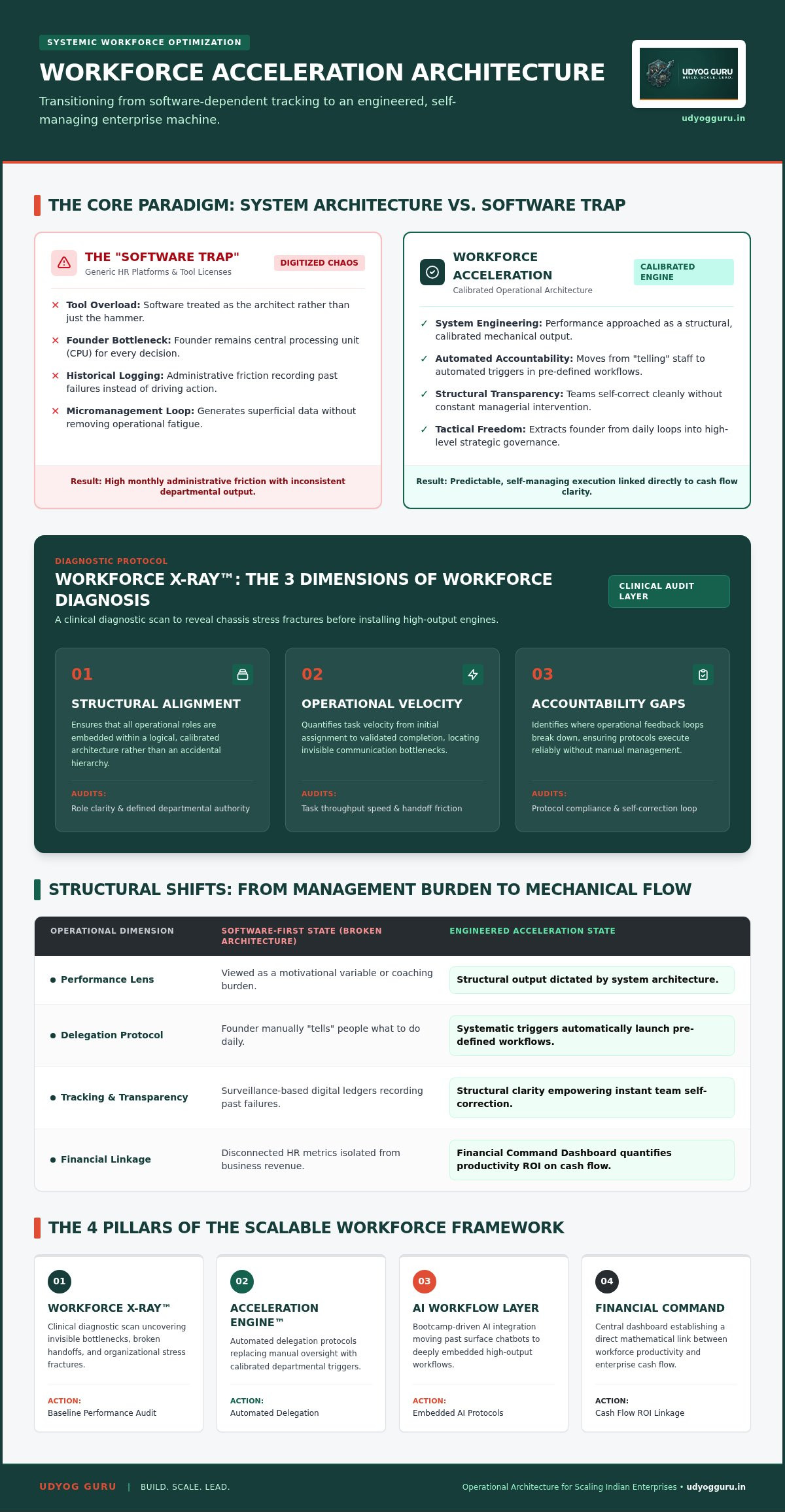
Performance isn't a motivational variable; it's a structural output. Many scaling Indian enterprises invest in employee performance optimization tools expecting a magical correction in productivity. They fail because they treat software as the architect rather than the hammer. Effective performance management requires a rigorous engineering approach that prioritizes system architecture over digital checklists. When you view your workforce as a machine to be calibrated rather than a group to be coached, the path to high-output results becomes clear.
The "Software Trap" occurs when generic HR platforms add layers of administrative friction. Instead of reducing the operational load, these tools often force managers into a cycle of manual data entry and "tracking" past failures. Real acceleration requires a shift from recording history to triggering future actions. You aren't looking for a digital ledger; you're looking for an engine that drives output through automated workflows. If a tool doesn't reduce the number of decisions you have to make daily, it's an administrative burden, not an optimization asset.
Diagnosis Before Prescription: The Missing Step
Prescription without diagnosis is malpractice in business. Installing high-end software into a fractured system only results in digitized chaos. A clinical scan, such as a Workforce X-Ray™, is essential to determine if low output stems from individual incompetence or systemic failure. Often, what looks like a personnel problem is actually a lack of structural transparency. Transparency isn't about surveillance. It's about providing the structural clarity that allows a team to self-correct without constant managerial intervention. Without this diagnostic step, you're simply automating your inefficiencies.
Founder Dependency as a Performance Bottleneck
Scaling enterprises often stall because the founder remains the central processing unit for every decision. Traditional employee performance optimization tools don't solve this; they often just give the founder more data to micromanage. The cost of owner-led delegation is high, leading to inconsistent departmental output and operational fatigue. Transitioning to automated accountability protocols removes the founder from the daily tactical loop. This shift allows the business to function as a self-sustaining machine. By installing systematic triggers, you move from "telling" people what to do to "triggering" the next step in a pre-defined workflow, ensuring the architecture drives the result.
Workforce X-Ray™: A Diagnostic Protocol for Team Transparency
Most employee performance optimization tools fail because they attempt to measure output without understanding the underlying architecture. A Workforce X-Ray™ isn't a survey; it's a clinical scan of human capital efficiency designed to reveal the structural integrity of your team. By mapping the workflow architecture, we can identify exactly where delegation breaks down and where "invisible" bottlenecks, like redundant communication loops, hemorrhage time. Mapping the workflow architecture reveals the exact coordinates where delegation protocols collapse. It's often found that tasks stall in departments where authority is poorly defined or where communication channels are fragmented.
Achieving operational clarity requires a baseline for quantitative performance auditing. While general workforce productivity data offers a macro view of industry trends, an internal diagnostic scan provides the granular detail needed for precise calibration. This process moves beyond surface-level tracking to reveal the friction points that prevent scaling. It's impossible to install a high-output engine into a chassis that hasn't been scanned for stress fractures. You must first understand the current load-bearing capacity of your departments before you can optimize their output.
The 3 Dimensions of Workforce Diagnosis
Our diagnostic framework categorizes enterprise health into three distinct layers. First, structural alignment ensures that roles are embedded within a logical architecture rather than an accidental hierarchy. Second, we measure operational velocity, which quantifies the speed at which tasks move from assignment to validated completion. Finally, we analyze accountability gaps to identify where the feedback loop fails, ensuring that every protocol is followed without manual intervention. These dimensions provide the data necessary to transition from founder-dependent oversight to systematic autonomy.
From Subjective Reviews to Objective Data
Traditional performance appraisals are often marred by manager bias and anecdotal evidence. Systematic scanning eliminates these variables by replacing intuition with objective datasets. The Workforce X-Ray™ is a rigorous, data-driven audit of enterprise health designed to identify structural inefficiencies within human capital systems. By integrating these findings with broader Workforce Optimization Strategies, founders can install a self-correcting workforce that functions independently of their daily presence.
If your current employee performance optimization tools only provide numbers without insights, it's time for a professional scan. You can initiate this process by scheduling a Workforce X-Ray™ to begin the systematic repair of your operational engine and reclaim your time as a strategist.
Engineering the Workforce Acceleration Engine™ for Scaling
Installing a Workforce Acceleration Engine™ is the definitive phase where diagnostic data transforms into operational momentum. While most employee performance optimization tools focus on retrospective tracking, this engine focuses on prospective output. It replaces the traditional management model of manual requests with a self-triggering architecture. High-performance behaviors are no longer left to individual discretion; they are standardized through rigorous operational protocols. This shift ensures that every department functions as a calibrated component of a larger machine, maintaining velocity regardless of the founder's physical presence.
The transition from "telling" to "triggering" is the hallmark of a mature enterprise. In a manual environment, the founder acts as the primary signal, initiating every task and resolving every conflict. In an engineered environment, the completion of one protocol automatically triggers the next. This reduces the cognitive load on leadership and ensures that the system manages the workflow. This structural reliability is essential for scaling, as it prevents the performance degradation that usually accompanies rapid headcount growth.
The Installation Protocol for High-Output Teams
Installing this engine requires a three-step protocol to ensure structural integrity and departmental alignment. First, you must define the specific "Output Metrics" for every role in the organization, ensuring every action contributes to the bottom line. Second, you design a communication architecture for zero-friction reporting, where data moves through the business without manual aggregation. Finally, you implement the automated accountability loop. This loop flags deviations from the protocol in real-time, allowing for immediate correction. By following these steps, you align human activity with mechanical precision, a necessity supported by workforce productivity data that links systematic efficiency to overall enterprise health.
Removing the Founder from the Operational Loop
Scaling enterprises often stall because the owner remains the primary processing unit for every critical decision. Founders must master the techniques for identifying operational bottlenecks that force them back into daily tactical intervention. The objective is to build a "System of Systems" where the engine manages the people, and the founder manages the engine. This level of operational clarity is achieved through the Business Process Systematization protocol. By removing yourself from the center of the architecture, you create a business that functions as an independent asset. This shift allows you to focus on high-level strategy while the engine maintains the high-output standards you've installed.
AI Protocols: Modernizing Performance Through Automated Workflows
AI is frequently reduced to a conversational novelty, yet its true utility in scaling enterprises lies in its capacity to function as a core operational layer. When integrated correctly, AI becomes the most sophisticated of all employee performance optimization tools, moving beyond static data collection to active workflow management. This is not about replacing human talent; it's about reallocating human capital toward high-value strategic execution by automating the repetitive managerial tasks that traditionally consume a founder's schedule. Reporting, scheduling, and basic auditing are no longer manual requirements but automated protocols within a larger business architecture.
Embedding automation into core workflows requires a disciplined approach to technology. Instead of fragmented software solutions, scaling businesses need a unified system where AI serves the existing architecture. This ensures that the technology remains a tool for efficiency rather than a source of new complexity. By shifting the burden of routine oversight to an AI-driven engine, you establish a baseline of operational integrity that functions 24/7 without fatigue or oversight.
The AI Implementation Roadmap for SMEs
Identifying 'AI-ready' processes is the first diagnostic step in a successful modernization strategy. Founders should consult the AI Roadmap for SMEs for a tiered framework on technology integration. This roadmap categorizes business functions based on their potential for automation, allowing for a phased installation of advanced protocols. AI protocols reduce human error in performance tracking by eliminating the subjective variance and manual entry mistakes inherent in traditional management models.
Technology Integration for Modern Founders
Modern founders must evolve from managers to systems architects who can build and maintain their own automation engines. The AI Tech Business Integration Bootcamp (Tier 3) provides the technical blueprint for this transition, teaching owners how to embed these technologies directly into their operational chassis. This approach significantly reduces the need for expensive custom software development, as it utilizes smart AI integration to bridge the gaps between existing systems. The goal is to ensure that technology serves the business architecture, providing the data-driven clarity required for high-output scaling.
To begin the systematic installation of these automated workflows, apply for the AI Tech Business Integration Bootcamp and modernize your enterprise architecture.
The Financial Command Dashboard: Quantifying Human Capital ROI
The final stage of enterprise engineering is the installation of a central nervous system that translates operational activity into fiscal reality. The Financial Command Dashboard serves as this diagnostic interface, ensuring that employee performance optimization tools do more than just track hours; they quantify the return on human capital in real-time. By linking individual output directly to profitability and cash flow metrics, founders gain the ability to see the business as a unified machine. This level of visibility exposes the "Cost of Inefficiency," highlighting exactly where departmental friction is hemorrhaging capital. Achieving this state of fiscal control is the prerequisite for predictable, scalable growth.
Operating without a command center is a form of structural blindness. Most SMEs struggle because their performance data is siloed from their financial data, making it impossible to determine if a high-performing team is actually a profitable one. The dashboard solves this by aggregating the output from your automated workflows and mapping it against your operational expenses. This creates a self-regulating system where every protocol adherence or deviation is immediately visible as a financial variable. It's the difference between guessing your way through a quarter and commanding a high-performance machine with total certainty.
Data-Driven Control Over the Organization
Maintaining total transparency requires tracking specific, high-leverage metrics that define the health of the enterprise architecture. These include Revenue per FTE, Protocol Adherence Rates, and the Operational Velocity Index. Data for these metrics is continuously updated as the Business Diagnostic Scan feeds granular insights into the command center. This feed ensures that the boardroom remains connected to the frontline, allowing for rapid calibration without manual auditing. When every role is quantified, the organization achieves a level of structural integrity that makes performance gaps impossible to hide.
The Path to Sustainable Scaling
Scaling is a risk-heavy process when based on intuition, but it becomes a logical progression when driven by financial data. Using the dashboard, founders can justify workforce expansion or technology investment based on the proven ROI of existing protocols. You move from "firefighting" daily crises to "commanding" a system designed for high-output execution. The transition to this level of maturity is the final step in the Scaling a Business framework. By installing these final layers of fiscal control, you ensure that your business remains a profitable, self-managing asset that can withstand the pressures of rapid national expansion.
Architecting the Future of Your Enterprise
Transitioning from founder-dependent operations to a self-managing workforce requires a fundamental shift from motivational management to rigorous structural engineering. Most employee performance optimization tools fail when they're applied to a fractured architecture; real progress begins with a clinical diagnosis of your human capital efficiency. By utilizing the proprietary Business X-Ray™ methodology, you can identify systemic failures and replace them with the tiered Acceleration Engine™ framework. This ensures that every department functions as a calibrated component of a high-output machine rather than a collection of disconnected tasks.
The path to sustainable scaling is paved with data-driven clarity and automated accountability. Whether you're embedding advanced protocols through our specialized AI Integration Bootcamp or monitoring ROI via the Financial Command Dashboard, the objective remains the same: a business that operates independently of your daily presence. It's time to stop managing chaos and start commanding a system designed for predictable growth. Book Your Business X-Ray™ Diagnostic Scan Today to begin the systematic calibration of your enterprise. Your journey toward operational excellence is a solvable puzzle of logic and process.
Frequently Asked Questions
What are the best employee performance optimization tools for SMEs in India?
The most effective employee performance optimization tools for Indian SMEs are those that combine diagnostic scanning with systematic acceleration engines. While generic HR software provides basic tracking, proprietary frameworks like the Workforce X-Ray™ and the Workforce Acceleration Engine™ offer the structural integrity needed for scaling. These systems focus on removing founder dependency and installing automated accountability protocols. This approach ensures that performance is an engineered output rather than a variable dependent on individual motivation or manual oversight.
How do I choose between performance management software and a systems-based approach?
Choosing between software and a systems-based approach depends on whether you require a digital ledger or a high-output machine. Performance management software often acts as a passive recording device, whereas a systems-based approach, such as the Business Acceleration Engine™, installs the operational architecture that drives results. If your goal is to eliminate departmental inconsistencies and achieve operational clarity, a structured system is superior to standalone software that lacks a diagnostic foundation or implementation roadmap.
Can AI really improve employee performance in a small business?
AI significantly improves performance by acting as a core operational layer that automates repetitive managerial tasks. Through the AI Tech Business Integration Bootcamp, founders learn to embed automation into existing workflows, reducing human error in reporting and scheduling. This reallocates human capital toward high-value strategic execution. Instead of viewing AI as a simple chatbot, small businesses should treat it as a technical protocol that enforces consistency and accelerates task completion across all departments.
How do I track employee output without micromanaging the team?
Tracking output without micromanagement requires the installation of automated accountability loops that flag deviations from protocol in real-time. By utilizing a Financial Command Dashboard, you gain visibility into departmental productivity without direct daily intervention. This system replaces manual check-ins with data-driven transparency, allowing the architecture to manage the people. You transition from a "founder-at-the-center" model to a "systems-architect" role where the engine triggers the next steps and validates task completion automatically.
What is the Workforce X-Ray™ and how does it differ from a standard appraisal?
The Workforce X-Ray™ is a clinical, data-driven audit of enterprise health rather than a subjective performance review. While standard appraisals rely on anecdotal evidence and manager bias, this diagnostic protocol scans the business for structural bottlenecks and communication gaps. It quantifies operational velocity and identifies where delegation protocols are failing. This provides a rigorous baseline for systematic repair, ensuring that every role is embedded within a logical architecture that supports sustainable scaling across the organization.
How much time does it take to install an automated delegation system?
The timeline for installing an automated delegation system depends on the complexity of your current architecture and the results of your initial diagnostic scan. Typically, the process involves a tiered implementation phase, starting with a Workforce X-Ray™ to identify gaps, followed by the installation of the Workforce Acceleration Engine™. This structured progression ensures that protocols are correctly embedded into your workflows. Most enterprises begin seeing significant improvements in operational clarity and team autonomy once the core accountability loops are activated.
Will these optimization tools help me remove myself from daily operations?
These employee performance optimization tools are specifically engineered to remove the founder from the daily tactical loop. By installing the Business Acceleration Engine™, you replace owner-led delegation with automated triggers that manage the workflow. This shift allows the business to function as an independent asset. When your workforce operates under a self-correcting system of systems, you reclaim your time to focus on high-level strategy and expansion rather than firefighting operational chaos.
How does a Financial Command Dashboard help in managing team performance?
A Financial Command Dashboard manages performance by linking granular employee output directly to profitability and cash flow metrics. This provides a central nervous system for the founder, offering real-time visibility into the "Cost of Inefficiency" across the organization. Instead of viewing productivity in isolation, you see its direct impact on fiscal health. This transparency allows for precise calibration of human capital and ensures that every departmental action contributes to the predictable growth of the enterprise.


