

A business that requires the constant, manual intervention of its founder isn't a scalable enterprise; it's a fragile entity prone to systemic collapse. Most entrepreneurs discover that their growth is capped not by market demand, but by the lack of a rigorous operational architecture. When you rely on tribal knowledge rather than standardized protocols, you invite inconsistency and burnout into your core operations. Implementing robust standard operating procedures for SMEs is the critical diagnostic step required to transition from a chaotic startup to a high-performance machine.
You likely recognize that your current over-involvement in daily tasks is preventing the strategic expansion your business deserves. This article provides the master blueprint for designing and installing an architectural framework that drives predictable growth and absolute accountability. We'll analyze the precise methodology for documenting workflows that function independently of your presence. By the end of this guide, you'll understand how to utilize tools like the Business X-Ray™ to identify operational gaps and deploy the Business Acceleration Engine™ to ensure your business runs with clinical precision. This is the structural recalibration required for sustainable scalability.
Key Takeaways
- Define the structural DNA of your organization by implementing standard operating procedures for SMEs that ensure consistent output and eliminate the risks associated with founder dependency.
- Identify the four essential architectural pillars—Operations, Finance, Sales, and Workforce—required to build a comprehensive operational framework for the 2026 business landscape.
- Execute a precision diagnostic scan using the Business X-Ray™ to isolate high-impact bottlenecks and map workflows before initiating the documentation process.
- Modernize your operational engine by integrating AI agents and automated triggers to transform static documents into "living protocols" that monitor compliance in real-time.
- Master the deployment phase by utilizing the Business Acceleration Engine™ to ensure seamless team adoption and drive continuous system optimization across all departments.
Standard Operating Procedures: The Structural Blueprint for SME Scalability
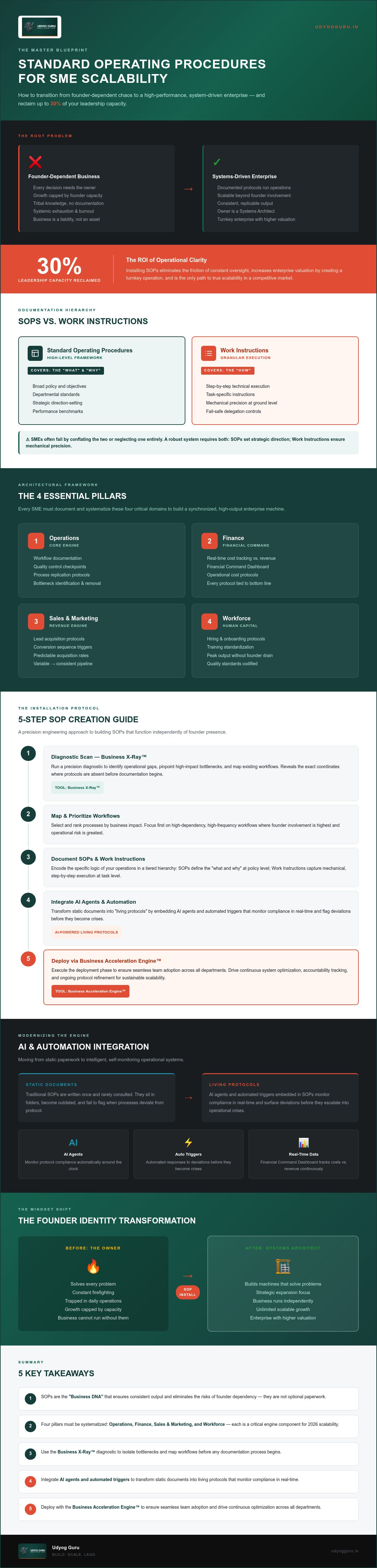
Standard operating procedures for SMEs represent the fundamental architectural code of a scalable enterprise. Rather than viewing them as optional paperwork, we treat them as the "Business DNA" that ensures consistent output across every department. This documentation encodes the specific logic of your operations, allowing the business to replicate success without your direct intervention. If your processes only exist in your mind, your business isn't an asset; it's a prison built on tribal knowledge and high-risk dependency.
Most SMEs fail because they remain trapped in a cycle of operational chaos. When founder dependency is high, every minor deviation requires the owner's attention, leading to systemic exhaustion and a hard ceiling on growth. We utilize the Business X-Ray™ to perform a precision scan of these bottlenecks. This diagnostic perspective reveals the exact coordinates where protocols are absent, enabling us to transition the business from reactive "firefighting" to a state of systematic management where the owner is no longer the primary bottleneck.
The ROI of Operational Clarity
The transition to a system-driven model yields a measurable return on investment that extends beyond basic efficiency metrics. By installing standard operating procedures for SMEs, you eliminate the friction of constant oversight and reclaim up to 30% of your leadership capacity. This structural clarity increases the enterprise's valuation by creating a turnkey operation that functions independently of any single individual. For the founder, the primary gain is the psychological shift from being an "Owner" who solves every problem to a "Systems Architect" who builds the machines that solve them. This shift is the only path to true scalability in a competitive market.
SOPs vs. Work Instructions
A complete operational engine requires a tiered hierarchy of documentation. We distinguish between high-level Standard Operating Procedures and granular Work Instructions. SOPs define the broad policy, objectives, and departmental standards; they provide the "what" and the "why." Work Instructions provide the technical, step-by-step execution required for specific tasks. SMEs often fail by conflating the two or neglecting one entirely. A robust system requires the SOP to set the strategic direction while the work instruction ensures mechanical precision at the ground level. This combination creates a fail-safe environment for delegation and quality control.
Architecting the Framework: Categories of Essential SME Protocols
Building a scalable entity requires more than generic documentation; it demands an architectural framework divided into four critical pillars: Operations, Finance, Sales and Marketing, and the Workforce. Each pillar serves as a specialized engine component within the broader business machine. Without these integrated standard operating procedures for SMEs, the business remains a collection of siloed activities rather than a synchronized, high-output system. Codifying these areas allows for a clinical assessment of performance and provides a clear map for expansion.
We engineer the Sales and Marketing pillar by installing protocols that transform lead acquisition from a variable guess into a predictable calculation. This involves documenting the exact triggers and conversion sequences required to maintain a consistent acquisition rate. Similarly, standardizing the human element is vital for long-term stability. By deploying workforce optimization strategies, you can codify hiring and training protocols, ensuring that every new addition to the team reaches peak output without draining founder resources or compromising quality standards.
The financial pillar must be integrated with the Financial Command Dashboard to ensure operational clarity. This integration allows for real-time tracking of operational costs against revenue, ensuring that every protocol contributes to the bottom line. To begin your structural overhaul, consider a diagnostic assessment to map your existing protocols and identify high-risk gaps.
Operational Protocols for High-Output Teams
High-output operations rely on the mechanical precision of their internal workflows. For product-based enterprises, this necessitates rigorous inventory and supply chain SOPs to prevent capital stagnation and stockouts. Service-based entities must implement delivery protocols that guarantee a "Gold Standard" output regardless of which team member executes the task. You should also establish communication protocols to eliminate the internal bottlenecks that occur when information flow is left to chance. These systems ensure that the "hardware" of your business remains calibrated for growth.
The Financial Command Layer
Financial integrity is maintained through a structured layer of fiscal protocols that remove ambiguity from money management. This includes automated cash flow management and reporting sequences that provide a clinical view of the business's health. You must establish a protocol for weekly fiscal health checkups utilizing the Command Dashboard to detect anomalies before they become systemic failures. Decentralized decision-making is then enabled through clear budgeting and expense approval workflows. This allows the machine to operate efficiently without constant manual overrides or micro-management from the founder.
The Installation Protocol: A 5-Step Engineering Guide to SOP Creation
Creating standard operating procedures for SMEs is not a creative writing exercise; it's a rigorous engineering project. We follow a strict 5-step installation protocol to ensure structural integrity and operational reliability. This methodical sequence prevents the common mistake of documenting inefficient or broken processes. The protocol follows a logical progression from initial diagnosis to full-scale automation:
- Step 1: Diagnostic Scan — Utilize the Business X-Ray™ to isolate high-impact bottlenecks within the current operation.
- Step 2: Process Mapping — Visualize the workflow logic to identify redundancies and critical decision points.
- Step 3: Drafting the Protocol — Write for the "Lowest Common Denominator" to ensure the system is fail-safe and easily transferable.
- Step 4: Stress Testing — Validate the documentation with active team members to expose hidden operational gaps.
- Step 5: Installation & Automation — Embed the final protocol into the Business Acceleration Engine™ for long-term compliance and growth.
The drafting phase is where many founders falter by assuming too much baseline knowledge. We advocate for a "Lowest Common Denominator" standard, which necessitates instructions so precise that they eliminate all subjective interpretation. This is followed by a clinical stress test. By observing a team member execute the protocol without external guidance, we can diagnose exactly where the communication breaks down. This validation step is the difference between a static document and a functional piece of business hardware.
Mapping the Workflow Architecture
Before documentation begins, we must visualize the logic of the system. We use detailed flowcharts to expose decision points and recursive loops that often hide inefficiencies. This "business-as-science" approach ensures that we aren't just documenting a broken process. By identifying operational bottlenecks during this mapping phase, we can re-engineer the workflow for maximum throughput before it's codified into a permanent protocol. This architectural clarity is what allows for true delegation without a loss in output quality.
Writing for Technical Precision
The efficacy of standard operating procedures for SMEs depends on the clinical precision of the language used. We utilize declarative statements to eliminate ambiguity and reduce the risk of human error. We favor the "Checklist Manifesto" approach, keeping documents lean and focused on actionable steps rather than bloated theory. Modern protocols should also integrate visual aids and video walkthroughs. These tools provide a multi-dimensional reference for teams, ensuring the "engine" runs smoothly without constant founder clarification. When instructions are visual and actionable, adoption rates increase significantly.
Modernizing the Engine: Integrating AI and Automation into Your SOPs
By 2026, the traditional static manual has become an operational liability. Standard operating procedures for SMEs must transition from "shelfware" into "Living Protocols" that function as the real-time operating system of the enterprise. When documentation remains disconnected from the actual flow of work, it fails to prevent errors or drive efficiency. We solve this by embedding AI agents directly into the workflow to monitor compliance and trigger diagnostic alerts at the first sign of deviation. This ensures that the protocol is followed with mechanical precision, regardless of who's executing the task.
This technical integration transforms the SOP from a passive reference into an active enforcement mechanism. We utilize the frameworks established in the AI Tech Business Integration Bootcamp to identify and automate repetitive administrative tasks. This shift ensures your human capital is reserved for high-level strategic execution rather than manual data entry. To begin automating your operational engine, you should secure your position in our upcoming integration program. By offloading low-level logic to automated systems, you harden your business against the risks of human fatigue and oversight.
AI-Driven Accountability Protocols
Accountability is no longer a matter of managerial intuition; it's a data-driven certainty. We integrate AI to automate the Workforce X-Ray™ process, tracking real-time output against the specific parameters defined in your protocols. This system provides a clinical assessment of team performance, identifying precisely where a workflow is breaking down or where a team member requires recalibration. By removing subjective oversight, you reduce the risk of human error in high-complexity technical processes, ensuring the machine maintains peak output without constant founder intervention. This level of transparency is essential for decentralized scaling.
Building a Future-Proof Tech Stack
The foundation of a scalable enterprise is a tech stack designed for AI implementation for SMEs. We leverage the "No-Code" revolution to build automated triggers and data bridges between your core applications. This transition from manual logs to automated data streams ensures that your SOPs are always informed by current operational realities. By selecting tools that support seamless data flow, you create a self-correcting ecosystem where protocols update dynamically based on performance metrics. This is the structural requirement for a business that intends to lead its sector in the coming years.
Scaling Beyond the Founder: Implementing SOPs via the Business Acceleration Engine™
The final stage of operational recalibration involves the active installation of your protocols into the team's daily environment. Standard operating procedures for SMEs are only as effective as the implementation engine that drives them. Without a structured rollout, even the most precise documentation remains inert. We utilize the Business Acceleration Engine™ to transition your organization from a state of founder-led chaos to a system-driven enterprise. This phase is not merely about distribution; it's about the clinical integration of protocols into the cultural and mechanical fabric of the business.
Achieving true "Founder Freedom" requires a complete identity shift from the Operator to the Systems Architect. In this new role, your primary responsibility is the health and calibration of the business machine rather than the execution of its individual tasks. Through the Business Process Systematization framework, we establish a cycle of periodic re-calibration. This ensures that as your market evolves, your protocols are updated to maintain peak efficiency. Systems are not static; they're dynamic components that require regular diagnostic tuning to support sustainable growth.
Overcoming Team Resistance to Systems
Team resistance is often a symptom of poor framing rather than a lack of competence. You must frame standard operating procedures for SMEs as tools for empowerment that provide a clear floor for performance, rather than as mechanisms for micro-management. To maintain the integrity of these systems, we recommend appointing a "Chief Systems Officer" or a designated systems lead. This individual acts as the internal auditor of your business architecture. By linking system adherence to objective performance metrics, you create an environment where high-output behavior is incentivized and operational deviations are immediately visible for repair.
The Path to Predictable Scaling
Standardized systems are the prerequisite for rapid geographic or market expansion. When your operations are codified, you can replicate your success in new territories with the same precision as a franchise model. The Financial Command Dashboard serves as the final validator of this success, providing the data required to confirm that your systems are delivering the expected margins. Scaling is no longer a high-risk gamble; it's a calculated engineering maneuver. To begin this transformation and diagnose the current state of your operations, the next logical step is to book a Business X-Ray™ for a comprehensive structural analysis.
Executing the Architectural Blueprint for 2026
Transitioning from a founder-dependent model to a scalable enterprise requires the clinical installation of rigorous systems. We've analyzed how standard operating procedures for SMEs function as the essential hardware of your organization, providing the structural integrity needed for predictable growth. By integrating AI-driven monitoring and the proprietary Business Acceleration Engine™ framework, you transform static documentation into an active, self-correcting operational engine. This evolution allows you to move beyond the limitations of manual oversight and adopt the role of a Systems Architect.
Our methodology relies on a data-driven diagnostic approach, utilizing expertise in AI Tech Business Integration to harden your workflows against human error. The result is a business that operates with mechanical precision, validated by the real-time insights of your Financial Command Dashboard. The path to sustainable expansion starts with a precise assessment of your current operational health. Every component of your business machine must be calibrated for maximum throughput and reliability.
Begin your diagnostic journey with a Business X-Ray™ scan today and calibrate your business for peak performance. It's the only logical step for securing long-term market leadership and achieving true operational freedom.
Frequently Asked Questions
What is the difference between an SOP and a simple checklist for SMEs?
An SOP defines the structural policy and departmental standards, whereas a checklist is a granular tool for task verification. Standard operating procedures for SMEs provide the logical framework for a process; checklists ensure the mechanical execution of that framework. Think of the SOP as the engineering blueprint and the checklist as the final safety inspection. Both are required to build a high-performance business machine that functions reliably without constant manual intervention.
How many SOPs does a typical small business actually need to start scaling?
Most scaling enterprises should begin with a core set of 10 to 15 high-impact protocols. These "Vital Few" should address the four architectural pillars: Operations, Finance, Sales and Marketing, and Workforce. Rather than attempting to document every minor task, focus on the bottlenecks identified during a Business X-Ray™ scan. This targeted approach ensures that your initial documentation efforts provide the highest return on operational clarity and structural integrity.
Can SOPs really help in reducing the owner’s daily involvement in the business?
Documented protocols are the primary mechanism for eliminating founder dependency and achieving operational freedom. By encoding your decision-making logic into standard operating procedures for SMEs, you enable your team to function as an extension of your strategic intent. This transition allows you to shift from a reactive "Operator" role to a "Systems Architect" persona, focusing on strategic expansion while the Business Acceleration Engine™ manages the daily mechanical output.
What is the best way to store and manage SOPs so the team actually uses them?
SOPs must be stored in a centralized, digital repository that acts as a "Living Protocol" for the team. Static paper manuals are obsolete; modern systems require cloud-based accessibility and integration with your task management tools. By embedding these protocols into your digital workflow, you ensure they're consulted during active execution. This structural integration is a key component of our Business Acceleration Engine™ implementation, driving high adoption rates and systemic consistency.
How often should an SME founder review and update their operational protocols?
We recommend a formal diagnostic review of all operational protocols on a quarterly basis. However, in a high-growth environment, systems should be updated dynamically whenever a process bottleneck is identified or a technological improvement is integrated. Utilizing the Business Process Systematization framework ensures that your architecture remains calibrated to current market realities. This prevents your "Business DNA" from becoming stagnant or misaligned with your scaling objectives.
Is it possible to automate the enforcement of SOPs using AI technology?
Automation of SOP enforcement is a core focus of our AI Tech Business Integration Bootcamp. AI agents can be configured to monitor workflow data and trigger immediate alerts when a protocol deviation occurs. This removes the need for constant human oversight and ensures a clinical level of accountability. By transitioning from manual logs to automated data streams, you harden your business against human error and maintain a high-output environment.
How do I handle employees who refuse to follow the new standard protocols?
Resistance is often a diagnostic indicator of poor system framing or a lack of accountability. We use the Workforce X-Ray™ to identify where compliance is failing and determine if the issue is a lack of training or a behavioral misalignment. You should frame protocols as tools for empowerment that provide a clear floor for performance. If non-compliance persists, you must link system adherence directly to performance metrics and professional advancement within the organization.
What are the first three SOPs every Indian SME should create to ensure financial control?
To secure financial control, Indian SMEs should prioritize SOPs for cash flow management, expense approval workflows, and weekly fiscal health checkups. These protocols should be integrated with the Financial Command Dashboard to provide real-time visibility into the organization's fiscal health. Establishing these three systems ensures that decision-making is decentralized but remains within strict budgetary parameters. This creates a fail-safe environment for scaling without the risk of capital mismanagement.


