
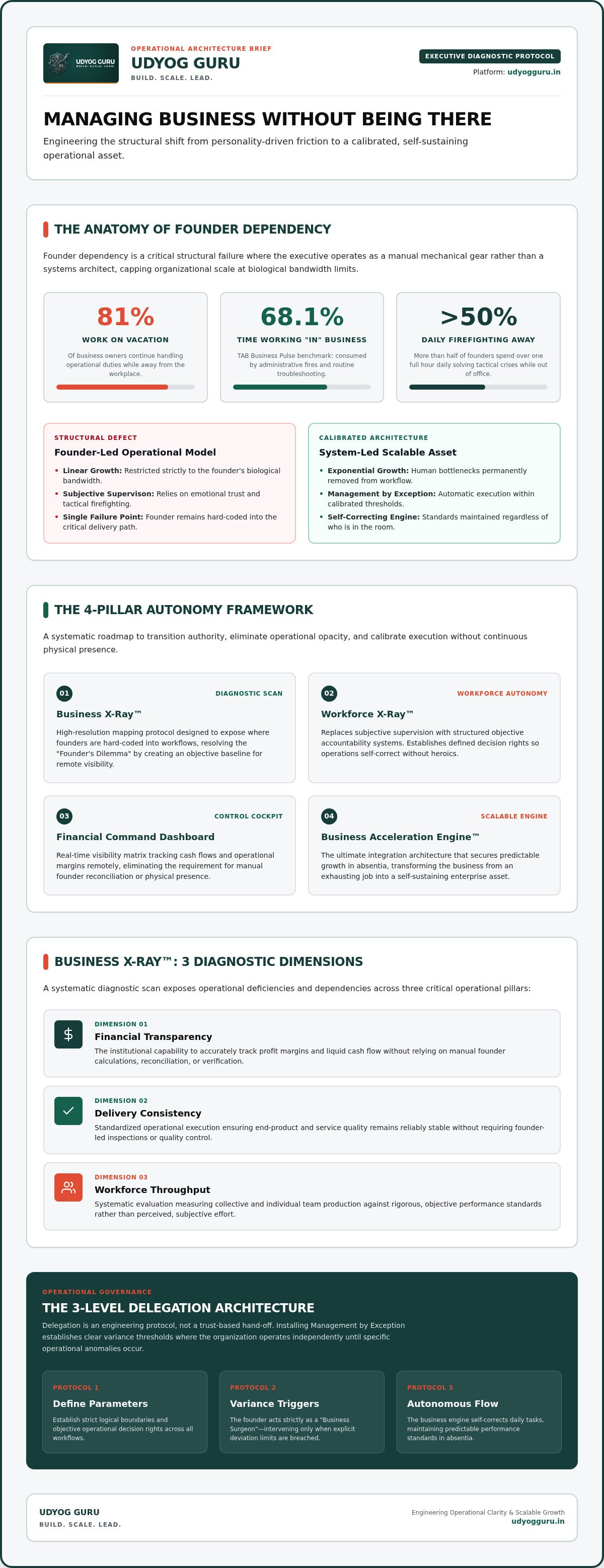
Statistics reveal that 81% of business owners work while on vacation, with more than half dedicating over an hour daily to operational fires while away. This suggests that for most founders, true autonomy is an unreached milestone. You likely recognize the diagnostic signs of a business in distress: inconsistent team performance, a lack of real-time visibility, and the reality that managing business without being there feels biologically impossible. It's a structural failure where the founder functions as a manual gear rather than a systems architect.
You deserve a business that operates with the precision of a calibrated machine. This article provides the structural engineering protocols required to transition from a founder-dependent operation to a self-sustaining asset. We'll analyze how to install a 3-level delegation architecture and utilize tools like the Business X-Ray™ to identify operational gaps. By the end of this guide, you'll understand how to implement a Financial Command Dashboard and the Business Acceleration Engine™ to ensure your company achieves predictable growth without your constant physical intervention.
Key Takeaways
- Identify structural defects in your leadership model where founder dependency acts as a primary operational bottleneck.
- Execute a clinical diagnosis of your company's architecture using the Business X-Ray™ to pinpoint manual dependencies.
- Transition from subjective supervision to objective accountability systems by deploying the Workforce X-Ray™ protocol.
- Establish a central command cockpit for managing business without being there through the real-time data of the Financial Command Dashboard.
- Calibrate the Business Acceleration Engine™ to ensure your organization scales as a self-sustaining machine rather than a personality-driven entity.
The Anatomy of Founder Dependency: Why Your Presence is a Bottleneck
Founder dependency isn't a leadership style; it's a structural defect where the CEO functions as the primary operational gear. Data from the TAB Business Pulse benchmark indicates that owners spend an average of 68.1% of their time working in the business, handling administrative fires and routine troubleshooting. This dependency creates a rigid ceiling on scalability because the organization's growth is limited by your biological bandwidth. Managing business without being there requires shifting from a personality-led model to a systems-driven architecture where the founder acts as an architect rather than a manual operator.
Many founders rely on "trust" as their primary management tool, yet trust is a poor substitute for a calibrated management system. Systems don't require emotional validation; they require logical parameters and clear decision rights. By installing a framework of management by exception, you define the thresholds for intervention, allowing the business to operate autonomously until a specific variance occurs. This clinical approach transforms you into a "Business Surgeon" who diagnoses structural weaknesses before attempting to delegate tasks, ensuring that delegation is an act of engineering rather than a hope-based hand-off.
Identifying Operational Bottlenecks
Stalled decision-making and tactical firefighting are clear symptoms of a compromised business engine. You must differentiate between working in the machinery and designing the strategic architecture of the enterprise. The process of identifying operational bottlenecks in business is the essential first step toward a successful exit or absentee ownership. Founder-led growth is linear and exhausting, whereas system-led growth is exponential because it removes the human bottleneck from the critical path of delivery. When you identify these friction points, you stop being the solution and start building the solution.
The Myth of the Essential Manager
Micromanagement isn't a personality trait; it's a symptom of poor system architecture. If you feel "essential" to daily operations, your processes have failed to provide the team with the necessary decision rights and clarity. Transitioning to a process-first mentality ensures that the business relies on repeatable protocols rather than individual heroics. Robust business process systematization creates the operational clarity required for autonomy. It replaces the need for constant supervision with a self-correcting engine that maintains performance standards regardless of who is in the room, allowing the founder to focus on high-level diagnostic repair.
The Diagnostic Protocol: Using Business X-Ray™ for Transparency
Transparency is the fundamental prerequisite for operational autonomy. You cannot expect to achieve the objective of managing business without being there if the internal mechanisms of your organization remain opaque to remote observation. The Business X-Ray™ functions as a high-resolution diagnostic tool designed to map the current architecture of an SME, exposing exactly where the founder is "hard-coded" into the critical path of the workflow. This mapping process validates Harvard Business Review's analysis of the founder's dilemma, which demonstrates how the initial drive for central control eventually becomes the primary structural constraint on scalability. Establishing a verified baseline for operational health is a technical requirement; it provides the visibility necessary to monitor performance from a distance without resorting to micromanagement.
Scanning for Structural Gaps
A rigorous business diagnostic scan categorizes operational deficiencies into three distinct dimensions to identify hidden dependencies:
- Financial transparency: The ability to track margins and cash flow without manual founder reconciliation.
- Delivery consistency: Ensuring service quality remains stable without founder-led quality control.
- Workforce throughput: Measuring team output against objective performance standards rather than subjective effort.
By identifying these structural gaps, you can prioritize repairs based on the severity of the bottleneck rather than responding to the loudest problem of the day. This systematic triage ensures that you are reinforcing the engine's core components before adding the stress of increased volume. It's about revealing where the business relies on your unique ability to resolve technical errors and replacing that reliance with a scalable protocol.
Installing Standard Operating Procedures (SOPs)
Standard operating procedures (SOPs) function as the logic-based software that runs the physical business machine. The common failure in delegation is creating static documentation that lacks a clear trigger for action. Effective standard operating procedures for SMEs must be engineered for execution and include built-in self-correcting feedback loops. These loops signal when a process has deviated from the calibrated baseline, allowing for managing business without being there by ensuring the system flags its own variances. This architecture transforms the workforce from a group of people waiting for instructions into a team of operators managing a self-diagnostic engine.
Founders who recognize these symptoms in their own operations should prioritize a comprehensive business audit to transition from manual oversight to systems-driven autonomy.
Engineering Workforce Autonomy with Workforce X-Ray™
Manual supervision is a structural failure that indicates a lack of trust in the underlying business architecture. When a founder's physical presence is required to maintain productivity, the workforce is operating on a "hero-led" model rather than a "system-led" one. To achieve the objective of managing business without being there, you must transition from subjective oversight to automated accountability systems. The Workforce X-Ray™ provides the necessary diagnostic framework to quantify individual and team output across five organizational dimensions, ensuring that every role is calibrated for maximum throughput without direct executive intervention.
The protocol for automated delegation requires setting precise parameters for success that function without manual check-ins. Gallup research on entrepreneurial delegation confirms that founders who empower their teams through clear authority and autonomy achieve substantially higher growth rates than those who remain operational bottlenecks. By installing the Workforce Acceleration Engine™, you create a high-output environment where remote or hybrid teams follow the system's logic rather than the founder's intuition. This shift ensures that performance remains consistent regardless of your physical location.
Quantitative Performance Auditing
Effective management requires moving from the observation of "effort" to the measurement of "output." Subjective performance reviews are often compromised by personal bias or the visible intensity of a team member's work. By implementing workforce optimization strategies, you establish objective metrics that signal health or distress in real-time. This quantitative auditing allows for managing business without being there because it replaces physical oversight with data-driven transparency. Reporting lines are restructured to function through the architecture, ensuring that variances are flagged automatically before they become critical failures.
Building a Self-Managing Team
A self-managing team isn't a collection of high-performers; it's a group of "system-ready" operators trained to follow the company's blueprint. The recruitment protocol must shift to identify individuals who value process adherence over individual heroics. Training should focus on the architecture of the business machine, teaching employees how to diagnose and repair their own workflows within the established SOPs. Incentivizing system adherence ensures that the team remains disciplined in their execution, allowing the founder to step back and assume the role of the Systems Architect. This cultural shift transforms the business into an independent asset that generates value through calibrated processes rather than constant human supervision.
Remote Control via the Financial Command Dashboard
The Financial Command Dashboard functions as the central cockpit for the absentee owner, translating raw operational data into a high-resolution diagnostic display. While most founders rely on lagging indicators like bank balances, surgical management requires a real-time view of the company's internal engine. This dashboard is the primary mechanism for managing business without being there, as it allows for a methodical 15-minute executive review of the organization's health each week. By standardizing these metrics, you eliminate the need for lengthy status meetings and manual reports that are often prone to human bias or error.
A calibrated dashboard must track five critical metrics to ensure structural integrity: rolling 13-week cash flow, Customer Acquisition Cost (CAC), Customer Lifetime Value (LTV), gross/net margins, and operational runway. Automating the collection of this data from your accounting and CRM systems ensures the dashboard reflects reality without manual entry. You must also install "Threshold Alerts" that act as automated triggers for intervention. If a metric deviates from the established baseline, the system alerts the founder immediately. It's a protocol that ensures your attention is only required during significant variances, preserving your bandwidth for strategic architecture.
Data-Driven Decision Protocols
Clinical data analysis removes the emotional volatility often associated with management. When you interpret financial scans from a distance, you can predict future operational needs with mathematical certainty rather than intuition. This protocol allows you to maintain fiscal control across national operations without a local presence. Decisions regarding scaling or cost-cutting become logical conclusions derived from the data, ensuring the business machine remains profitable and efficient. To install these control systems in your organization, you should explore the Financial Command Dashboard implementation services.
Integrating AI for Operational Oversight
Artificial Intelligence now serves as the digital supervisor that monitors workflow adherence in real-time. By utilizing insights from the AI Tech Business Integration Bootcamp, founders can deploy autonomous agents to flag deviations in SOP execution. A comprehensive ai implementation roadmap for smes secures the business against human error by automating Level-1 deflections and internal coordination. You don't need to be physically present to ensure that the engine runs at peak performance, as this technological layer provides the ultimate safeguard for a founder-independent asset.
The Business Acceleration Engine™: Scaling in Absentia
The Business Acceleration Engine™ represents the final tier of owner-independence, functioning as the primary mechanism for exponential expansion. While competitors often suggest that scaling is merely a matter of increasing headcount, a clinical analysis reveals that adding personnel into a fragile, founder-dependent environment only creates a larger, more complex bottleneck. True scalability is achieved when the organization's growth is no longer tethered to the founder’s personal bandwidth. By installing this engine, you complete the transition from "Business Owner" to "Systems Architect," ensuring the enterprise can handle increased volume with the same precision as a calibrated machine. This is the ultimate realization of managing business without being there, where the founder’s role shifts from an operator to a strategist focused on high-level calibration.
The Systems Architect doesn't manage people; they manage the systems that manage the people. This distinction is critical for managing business without being there because it shifts the focus from individual performance to systemic throughput. When the architecture is sound, the business machine generates value with mathematical consistency. This shift ensures that the company remains an independent asset rather than a job that requires your constant presence. Scaling becomes a technical process of increasing inputs into a proven engine, rather than a frantic effort to keep up with demand.
Architecting for Sustainable Growth
Effective scaling a business requires a robust structural foundation that can withstand the stresses of rapid expansion. In the 2026 operational landscape, the protocol for national expansion has shifted away from physical headquarters toward decentralized, high-output units managed via digital oversight. The Business Acceleration Engine™ ensures that revenue generation is predictable and repeatable, regardless of geographic dispersion. This calibration allows for the installation of new service units or regional branches with minimal friction, as the core operating logic is already hard-coded into the company’s architecture. It's about building a machine that can be replicated across markets without diluting the quality of delivery.
Your Implementation Roadmap
Achieving operational autonomy is a progressive sequence that begins with a Tier 1 diagnosis and culminates in Tier 3 AI integration. The timeline for this transition typically spans 60 to 90 days, moving through the systematic installation of the Business X-Ray™ and the Financial Command Dashboard before activating the full acceleration engine. This phased approach ensures that each layer of the business is reinforced before the next level of complexity is introduced. The roadmap is a clinical installation process, requiring the precise calibration of lead generation and sales conversion playbooks. To begin this diagnostic journey and identify the specific bottlenecks restricting your growth, you should Audit your business architecture with Udyog Guru today. This initial assessment provides the blueprint required to build a business that functions as an independent, scalable asset.
Architecting Your Operational Exit
The transition from manual operator to Systems Architect is a technical prerequisite for sustainable scaling. By utilizing the proprietary Business X-Ray™ diagnostic framework, you isolate the structural dependencies that restrict your organizational bandwidth. Establishing transparency via the Financial Command Dashboard ensures that managing business without being there is a function of rigorous data analysis rather than emotional intuition. Our expertise in AI-driven business automation and national-scale systems implementation provides the engineering protocols required to calibrate your enterprise for autonomous performance.
It's time to replace tactical firefighting with strategic architecture. You can transform your company from a founder-dependent operation into a self-sustaining asset that generates value regardless of your physical location. This process isn't about motivational shifts; it's about the clinical installation of robust operating engines. By adopting these protocols, you ensure your business remains resilient, profitable, and ready for expansion. You've the blueprint; now you must execute the installation.
Install the Business Acceleration Engine™ in your organization today to secure your operational future.
Frequently Asked Questions
How do I start managing my business without being there?
The process begins with a rigorous diagnostic scan of your current operations. You must use the Business X-Ray™ to identify exactly where your physical presence acts as a bottleneck. Once these founder-dependent gaps are mapped, you install the Business Acceleration Engine™ to replace manual oversight with logic-based protocols. This transition requires shifting from a personality-led model to a systems-driven architecture where the engine, not the individual, drives the daily workflow and delivery.
Can a small business really run without the founder?
Small businesses can operate autonomously if they are engineered as independent assets rather than personal jobs. Most small enterprises fail in absentia because they lack documented logic and rely on the founder's intuition. By implementing the Workforce Acceleration Engine™, you install a framework where routine tasks, sales conversions, and service delivery occur with mathematical consistency. This ensures the organization remains a self-sustaining machine that functions predictably regardless of your daily physical involvement.
What are the best tools for remote business oversight?
Effective remote oversight requires a centralized cockpit like the Financial Command Dashboard. This tool provides real-time visibility into five critical metrics, including cash flow and gross margins, without requiring manual data entry. Additionally, the Workforce X-Ray™ quantifies team throughput across five organizational dimensions. These instruments facilitate managing business without being there by replacing physical check-ins with data-driven monitoring, ensuring you only intervene when the system flags a specific operational variance.
How do I ensure employee accountability when I am not present?
Accountability is a structural achievement realized through objective performance metrics rather than subjective supervision. You must utilize the Workforce X-Ray™ to establish clear parameters for success that function without manual check-ins. When roles are calibrated for maximum throughput, the system itself enforces discipline. Employees are trained to follow the company’s architecture rather than a leader’s intuition, ensuring that reporting lines and automated feedback loops maintain high output even in your absence.
What is the role of SOPs in absentee management?
Standard operating procedures (SOPs) function as the logic-based software that runs the physical business machine. In an absentee model, SOPs must be engineered for execution rather than simple documentation. They provide the "if-then" parameters required for team members to handle routine tasks and Level-1 deflections autonomously. A robust SOP architecture ensures the organization remains self-correcting, which allows the founder to assume the role of a Systems Architect focused on high-level calibration.
How often should I check my business dashboard?
A methodical 15-minute executive review once per week is the standard cadence for a calibrated operation. The Financial Command Dashboard is designed to highlight variances through threshold alerts, which means your investigation is only required when data points deviate from the established baseline. This disciplined approach prevents the founder from reverting to micromanagement. It ensures you maintain high-level visibility into financial health without becoming a bottleneck in the organization’s daily decision-making path.
Is AI necessary for managing a business remotely in 2026?
AI is a critical safeguard for securing a business against human error and operational friction in the current landscape. Through the AI Tech Business Integration Bootcamp, founders learn to deploy autonomous agents that monitor workflow adherence and automate internal coordination. While not strictly mandatory, AI provides a digital supervisor layer that achieves significant routine query deflection. This makes managing business without being there more efficient, as technology handles the repetitive monitoring of system adherence.
What happens if the system fails while I am away?
A well-engineered business architecture includes built-in redundancy and clear escalation protocols. If a process fails or a metric deviates, the Financial Command Dashboard triggers an immediate threshold alert to the designated system operator. This ensures that technical errors are identified and diagnosed in real-time. The goal of a systems-driven business is not to eliminate every possible failure, but to ensure the organization possesses the diagnostic capability to flag and resolve variances through established protocols.


