

Adding more headcount to an uncalibrated enterprise doesn't create scale; it merely multiplies operational friction. If you are diagnosing how to systemize a business in India, you've likely realized that sheer personal stamina cannot repair fundamental defects in your workflow architecture. Every day dissolves into relentless firefighting, key talent exits due to absent accountability protocols, and opaque financial visibility turns strategic forecasting into pure guesswork.
You already recognize that relying on founder willpower is an unsustainable survival tactic rather than an enterprise strategy. In this 2026 guide, you will discover the clinical, diagnostic framework designed to transition your operations from founder-dependent chaos into a scalable, AI-integrated machine. We break down the systematic calibration of your core workflows, integrate autonomous operational protocols, and outline the structural blueprint required to let you govern as a systems architect over an independent, high-performance asset.
Key Takeaways
- Execute a clinical Business X-Ray™ to map operational bottlenecks and isolate founder dependency before implementing structural workflows.
- Engineer centralized Standard Operating Procedures that convert fragmented operational knowledge into a scalable, execution-ready blueprint.
- Deploy the Workforce X-Ray™ to quantitatively audit internal capacity and shift management protocols from constant employee monitoring to self-regulating systems.
- Learn how to systemize a business in India by embedding agentic automation through the AI Tech Business Integration Bootcamp to handle repetitive multi-step operations.
- Install the Financial Command Dashboard to replace lagging retrospective statements with real-time fiscal telemetry and calibrated cash flow oversight.
The Diagnostic Protocol: Identifying Operational Pathologies
Business systemization isn't a software implementation exercise. It's an intentional architectural shift from founder-led improvisation to a calibrated, process-driven structure. Many business leaders attempt to resolve internal friction by hastily purchasing SaaS subscriptions or adding mid-level managers. Yet, automating an undocumented, defective process merely accelerates systemic dysfunction. True systemization demands a clinical intervention that isolates structural friction before writing code or altering workflows.
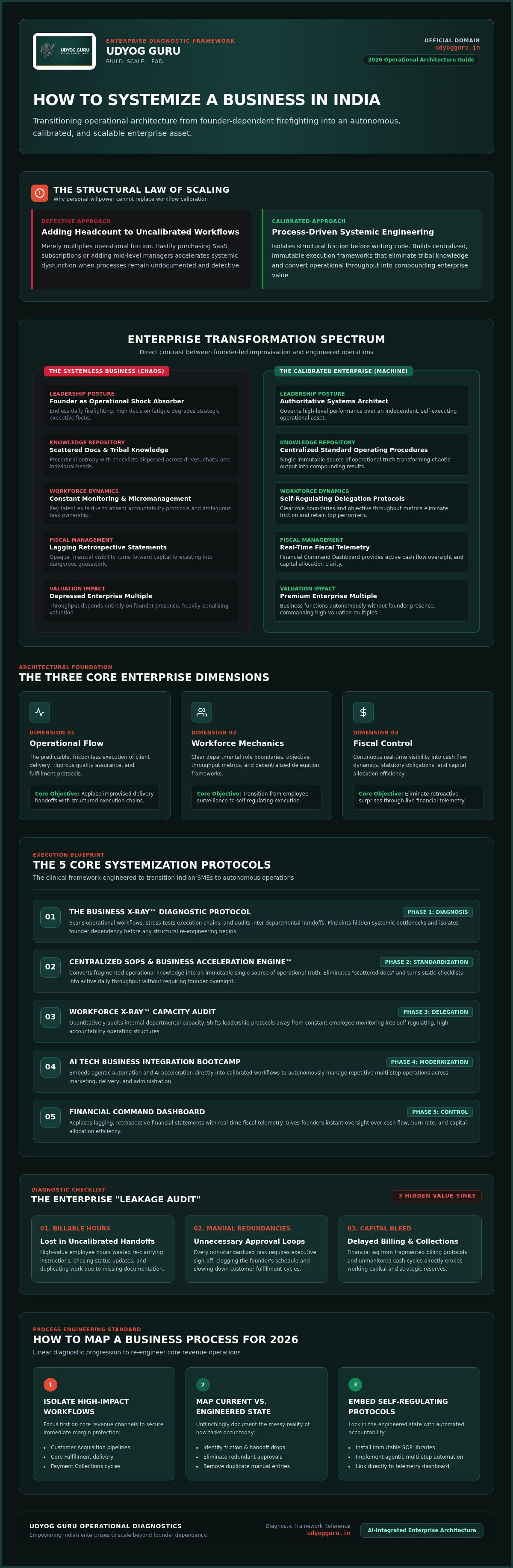
Founder firefighting isn't a personal discipline flaw; it's a structural failure. When operational knowledge lives solely in the founder's head, the enterprise suffers from chronic decision bottlenecks. Understanding how to systemize a business in India requires treating the enterprise as a unified machine governed across three core dimensions:
- Operational Flow: The predictable execution of client delivery, quality assurance, and fulfillment protocols.
- Workforce Mechanics: Role clarity, objective throughput metrics, and decentralized delegation frameworks.
- Fiscal Control: Continuous visibility into cash flow, statutory obligations, and capital allocation efficiency.
The Symptoms of a Systemless Business
A systemless organization leaks enterprise value through daily operational friction. Every ambiguous escalation sent to the executive desk generates decision fatigue, degrading high-level strategic focus. When daily throughput depends entirely on founder presence, the business cannot scale and commands a lower enterprise multiple during valuation events. To stop this drain, you must execute a comprehensive "Leakage Audit" across your teams, identifying exactly where billable hours, redundant manual entries, and capital disappear due to missing documentation.
The Business X-Ray™ Framework
You cannot calibrate what you haven't diagnosed. Attempting to deploy automation before auditing baseline mechanics leads directly to wasted capital and team frustration. The process begins with rigorous clinical scanning: auditing inter-departmental handoffs, stress-testing execution chains, and cataloging every hidden bottleneck within the operational machinery. By mapping operational realities against formal standard operating procedures (SOPs), organizations replace tribal knowledge with objective transparency.
The Business X-Ray™ serves as the definitive diagnostic protocol for Indian SMEs to scan operational workflows, pinpoint systemic bottlenecks, and establish baseline transparency before structural engineering begins.
Once this baseline audit exposes dormant redundancies, the founder ceases acting as an operational shock absorber. When evaluating how to systemize a business in India, this diagnostic scan provides the objective telemetry required to reposition the business leader from an operational laborer into an authoritative Systems Architect.
Architecting the Foundation: Engineering Scalable SOPs
Standard Operating Procedures are not passive administrative paperwork; they are the functional blueprints of your business machine. Most expanding firms stumble into the trap of "scattered docs," dispersing checklists across local hard drives, cloud documents, and chat threads. This fragmented approach guarantees procedural entropy. Implementing rigorous business process systematization establishes an immutable, single source of operational truth that transforms unpredictable performance into repeatable, compounding output.
Static checklists don't generate momentum on their own. To drive systematic execution without founder oversight, Indian enterprises require the installation of the Business Acceleration Engine™, a structural framework that converts documented protocols into active, daily throughput. Learning how to systemize a business in India means shifting from reactive delegation to an operational architecture that enforces its own standards.
How to Map a Business Process for 2026
Effective process engineering demands a linear, three-stage diagnostic progression:
- Identify High-Impact Revenue Workflows: Map customer acquisition, core fulfillment, and payment collections first. These deliver immediate margin protection.
- Map Current vs. Engineered State: Document the messy reality of how tasks occur today, then systematically eliminate redundant approvals, manual entries, and friction points to engineer the ideal path.
- Establish Version Control Protocols: Assign unambiguous ownership for every operational document, ensuring quarterly calibrations align with regulatory updates and operational shifts.
Removing Founder Dependency through Documentation
Founders frequently run into operational bottlenecks by repeatedly solving identical execution problems. Apply the "Rule of Three": if any operational sequence is performed thrice, it must be codified into a standard protocol. Convert these assets into self-serve onboarding engines, enabling new hires to execute production workflows autonomously from day one. You can read our detailed protocol on identifying operational bottlenecks in business to isolate the specific functional areas starving for standardized structure.
For organizations ready to dismantle tribal knowledge and build a resilient operating blueprint, partnering with specialized architects at udyogguru.in provides the structural clarity necessary to install permanent systems that run without founder intervention.
Workforce Optimization: Systemizing Delegation and Accountability
Micro-managing personnel is an exhausting symptom of missing architecture. When founders spend their days monitoring staff rather than governing systems, execution speed collapses under subjective oversight. True operational stability requires shifting from supervising individuals to managing the structural rules that guide them. You must treat your workforce as an interconnected execution apparatus where accountability is engineered directly into workflows, rather than extracted through constant pressure.
Subjective performance reviews cannot fix systemic misalignment. That repair requires the Workforce X-Ray™, a quantitative diagnostic protocol that audits team capacity, pinpoints skill imbalances, and identifies hidden execution drag. By running this diagnostic, leadership gains objective data on where workflows stall. Installing the Workforce Acceleration Engine™ immediately follows, establishing automated delegation rules that route tasks, manage dependencies, and enforce deadlines without executive intervention. This framework is central to how to systemize a business in India, ensuring operations advance based on documented triggers rather than founder memory.
Engineering High-Output Teams
High-output organizations don't rely on generic job descriptions. They define uncompromising Roles and Responsibilities (R&R) linked directly to measurable throughput. Implementing proven workforce optimization strategies allows companies to eliminate role redundancy and maximize output per team member. When execution fails, the system enforces systemic repair instead of personal blame:
- Isolate the Defect: Determine whether the failure stemmed from ambiguous documentation, inadequate tooling, or execution error.
- Calibrate the Protocol: Refine the operating standard immediately to prevent recurrence.
- Re-anchor Ownership: Re-establish clear, single-point accountability for the newly calibrated workflow.
Automated Performance Tracking
Real-time output dashboards render subjective oversight obsolete. By calibrating role-specific Key Performance Indicators (KPIs) into the company's daily workflow, every employee monitors their own operational velocity against empirical standards. This quantitative visibility completely eliminates the need for disruptive status update meetings, reducing management friction and aligning team focus entirely on output.
Transforming accountability from personal friction into an automated operational discipline is how leaders master how to systemize a business in India. Clear metrics create autonomy, allowing the executive to orchestrate growth from above rather than policing daily tasks from within.
Installing the AI Acceleration Engine: Modernizing Operations
Ad-hoc prompting and experimental chatbots are no longer sufficient for competitive operations. Operating in 2026 requires embedding artificial intelligence as an infrastructural engine directly within your standard workflows. According to Deloitte's 2026 State of AI in the Enterprise report, 40% of Indian respondents reported significant or full AI deployment across everyday business operations. Surviving this technological inflection point requires moving beyond superficial novelties to install structured machine intelligence into your operational core. To build this capability systematically, organizations can follow a calibrated AI implementation roadmap for SMEs that aligns technological tooling directly with enterprise objectives.
Achieving this level of operational maturity does not require expensive custom software development. Modern system architecture utilizes robust, commercial no-code platforms and pre-built integration engines to connect disconnected business functions. When examining how to systemize a business in India, the goal is simple: eliminate manual friction points by automating administrative handoffs between functional departments.
AI Protocols for Operational Efficiency
The transition begins by isolating repetitive, high-volume tasks that waste billable capacity. Focus systemization efforts on three core operational friction zones:
- Routine Data Synchronization: Auto-reconciling purchase orders, vendor invoices, and compliance documentation across accounting portals.
- Customer Support Triage: Deploying conversational agents over enterprise messaging channels to resolve common inquiries instantly.
- Autonomous Handoffs: Utilizing multi-step agentic workflows that parse incoming documents, validate fields, and route approvals without staff involvement.
The Tech-Integrated Founder
Replacing manual administrative oversight with algorithmic guardrails restores executive focus. By deploying automated telemetry that monitors workflow velocity, founders can observe systemic performance from a 10,000-foot vantage point. These diagnostic layers execute predictive bottleneck analysis, identifying capacity shortages and processing delays before they impact delivery timelines or client relationships.
The AI Tech Business Integration Bootcamp provides founders with a structured, step-by-step implementation plan to embed autonomous workflows directly into their operating core. To modernize your enterprise workflows and implement these autonomous protocols, register today at udyogguru.in and transform your organization into a scalable operational machine.
The Financial Command Center: Data-Driven Control
Traditional accounting acts as an operational autopsy. Reviewing historical financial statements three weeks after month-end tells you where capital died, not where it is leaking right now. To maintain sovereign control over an enterprise, founders must graduate from historical bookkeeping to real-time fiscal telemetry. Mastering how to systemize a business in India requires an authoritative financial cockpit that links daily operational output directly to live cash flow dynamics.
The Financial Command Dashboard functions as this central executive cockpit. Instead of relying on gut feelings or fragmented spreadsheets, leadership gains an unbroken visual read on liquidity, statutory exposure, and net margins. Systemizing your cash reserves is fundamental to scaling a business, ensuring increased order volumes do not trigger an unforeseen working capital collapse.
Building the Founder’s Command Dashboard
Executive clarity requires synthesizing scattered fiscal data into high-signal indicators. The command architecture tracks three non-negotiable vectors in real time:
- Live Unit Economics: Continuous tracking of contribution margins, acquisition customer costs, and operational delivery expense per contract.
- Dynamic Working Capital: Daily automated monitoring of Accounts Receivable and Accounts Payable cycles, safeguarding liquidity against supply disruptions.
- Statutory Reserve Telemetry: Automatic allocations for direct and indirect taxes, preventing regulatory compliance shocks from draining operating cash.
Predictable Growth through Financial Systems
Transitioning from intuition to structural analytics converts expansion from a gamble into an engineered science. Historical pipeline data and fulfillment velocity feed predictive models that calculate the exact working capital required for each unit of growth. Rather than guessing when to expand plant capacity or onboard talent, the system signals precise liquidity triggers required for capital allocation.
Understanding how to systemize a business in India means treating your treasury as a precision instrument rather than a passive bank balance. By codifying reinvestment percentages and establishing clinical expenditure controls, the business functions as an autonomous, wealth-generating asset that scales safely within predefined fiscal boundaries.
Engineering Your Transition from Firefighter to Systems Architect
Scaling an enterprise doesn't require longer working hours; it demands an uncompromising architectural overhaul. Mastering how to systemize a business in India means eliminating founder dependency by transforming undocumented tribal habits into self-executing operational blueprints. When your workflows run on calibrated protocols and real-time telemetry, your enterprise evolves from a fragile job into an independent, high-yield asset.
This structural transformation begins with our proprietary Business X-Ray™ diagnostic protocol to expose hidden operational pathologies. By deploying the tiered Business Acceleration Engine™ framework and modernizing through the AI Tech Business Integration Bootcamp, you install durable systems that govern delegation, cash flow, and execution without your constant oversight. Take the first definitive step toward building a self-sustaining enterprise: Schedule Your Business X-Ray™ Diagnostic Scan Today.
Frequently Asked Questions
What is the first step to systemize a business in India?
The first step is executing a comprehensive diagnostic scan rather than writing arbitrary checklists or buying software. When analyzing how to systemize a business in India, you must isolate root pathologies across operations, workforce mechanics, and cash flow. Utilizing a tool like the Business X-Ray™ reveals hidden operational bottlenecks, undocumented single points of failure, and baseline friction points before you install any structural frameworks or workflow protocols.
How long does it take to see results from business systemization?
Initial operational relief typically registers within four to six weeks of isolating systemic bottlenecks and codifying high-impact revenue workflows. Full stabilization across delegation, reporting, and fulfillment mechanics usually requires a tiered implementation over ninety to one hundred twenty days. Installing the Business Acceleration Engine™ ensures that newly calibrated standard operating procedures convert into daily throughput rapidly, replacing founder intervention with predictable, autonomous execution.
Can a small business with fewer than 10 employees be systemized?
Yes, systemizing an early-stage team provides the structural scaffolding necessary to scale without operational chaos. Smaller enterprises actually implement procedural calibrations faster because they carry less legacy friction. Codifying basic role responsibilities and core fulfillment blueprints early prevents the operational rot that typically strikes growing Indian companies. It ensures that expanding your headcount compounds output rather than multiplying administrative confusion.
What is the difference between a Business X-Ray™ and a standard audit?
A standard audit evaluates historical compliance or financial reconciliations retrospectively, documenting what occurred in the past. Conversely, the Business X-Ray™ operates as a live diagnostic scan of your entire enterprise machinery. It examines operational handoffs, workforce capacity utilization, and workflow dependencies in real time. This identifies dormant bottlenecks and systemic vulnerabilities, providing an actionable blueprint for structural repair rather than a passive record of historical performance.
Do I need custom software to systemize my business operations?
No, custom software development is entirely unnecessary and often introduces technical debt. Modern enterprise architecture leverages off-the-shelf platforms, robust API connections, and no-code automation engines to connect disparate workflows. Understanding how to systemize a business in India focuses on engineering clear protocols first. Once an operational standard functions manually without friction, low-cost digital tools and automated triggers enforce execution without custom engineering overhead.
How does systemization help in reducing founder burnout?
Founder burnout stems from chronic decision fatigue caused by acting as an operational shock absorber for daily escalations. Systemization codifies your decision-making frameworks into immutable operating blueprints and automated delegation protocols. By deploying the Workforce Acceleration Engine™, operational responsibilities route autonomously to team members based on clear metrics. This shifts the executive role from a tactical firefighter to a systems architect who governs an independent asset.
Is AI integration necessary for business systemization in 2026?
AI integration has shifted from an optional novelty to a core infrastructure requirement for competitive Indian enterprises. In 2026, autonomous agentic workflows handle multi-step operational tasks like vendor invoice reconciliation, data triage, and customer response routing without staff latency. Through the AI Tech Business Integration Bootcamp, organizations embed scalable technology directly into their existing SOPs, systematically removing human touchpoints from repetitive administrative execution.
How do I ensure my team follows the new systems and SOPs?
Compliance failures happen when systems rely on personal vigilance rather than architectural enforcement. Instead of policing individuals, install automated verification checkpoints and output dashboards that make procedural adherence mandatory for task completion. Conducting a Workforce X-Ray™ establishes objective capacity and performance telemetry, while clear Key Performance Indicators link daily output directly to individual accountability, ensuring processes run consistently without constant executive supervision.


