
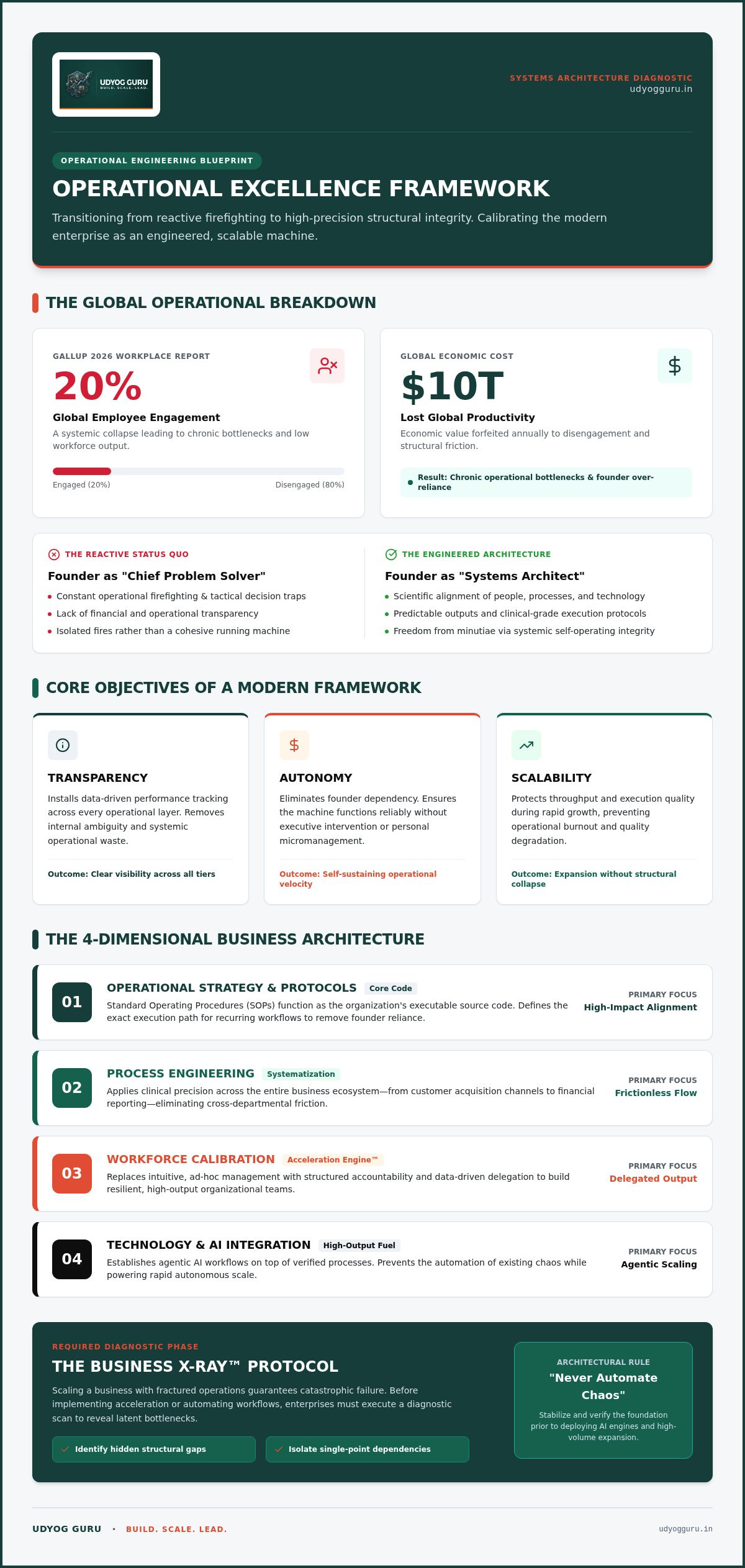
Gallup’s State of the Global Workplace: 2026 Report reveals that global employee engagement has dropped to 20 percent, a systemic failure costing the global economy an estimated 10 trillion dollars in lost productivity. For the scaling enterprise, this manifests as chronic operational bottlenecks and a heavy dependency on the founder for tactical decisions. You likely recognize the symptoms: constant firefighting, a lack of financial transparency, and a growth trajectory that feels unsustainable. If you don't address the underlying structural integrity, your business will remain a collection of isolated fires rather than a cohesive machine.
It's time to stop acting as a manager and start operating as a systems architect. This article provides a rigorous operational excellence framework designed to treat your business as a machine requiring precise calibration. We will move beyond theory to install a diagnostic architecture that eliminates operational chaos. You will discover how to implement a predictable engine for growth, allowing you to secure freedom from daily minutiae while building a scalable infrastructure that supports expansion without burnout. We will analyze the four dimensional layers of business architecture, ensuring your organization functions with the clinical precision of a high-performance engine.
Key Takeaways
- Transition from reactive firefighting to a scientific operational excellence framework that aligns people, processes, and technology for predictable scaling.
- Understand the necessity of the Business X-Ray™ diagnostic protocol to identify systemic bottlenecks before they're amplified by expansion.
- Implement the Workforce Acceleration Engine™ to replace intuitive management with data-driven delegation and structural accountability.
- Establish AI-driven agentic workflows that act as the high-output fuel for your modern business architecture.
Defining the Operational Excellence Framework: From Chaos to Structural Integrity
Operational excellence is not a vague management philosophy; it's the scientific alignment of people, processes, and technology to produce predictable, high-precision outputs. By establishing a rigorous operational excellence framework, an enterprise transitions from a state of reactive firefighting to one of structural integrity. This methodology draws from established operational excellence principles but applies them through a clinical lens, treating the business as a complex machine that requires precise calibration rather than motivational coaching.
Traditional management models frequently fail because they lack a diagnostic protocol to identify root-cause bottlenecks. Founders often find themselves trapped as the 'Chief Problem Solver,' a role that creates a high dependency on their daily presence and decision-making. To scale effectively, the founder’s role must evolve into that of a Systems Architect. This shift requires moving away from intuitive fixes and toward a systematic architecture where every business function operates according to defined protocols rather than individual whims.
The Core Objectives of a Modern Framework
A modern operational excellence framework prioritizes three structural outcomes to ensure long-term stability and performance:
- Transparency: Establishing data-driven performance tracking ensures that every operational layer is visible and measurable, removing the ambiguity that leads to waste.
- Autonomy: Removing founder dependency allows the machine to function without constant executive intervention, creating a business that runs independently of any single individual.
- Scalability: Creating an infrastructure that maintains output quality during rapid growth prevents the burnout and quality degradation often associated with manual oversight.
Why SMEs Require a Specialized Protocol
While methodologies like Lean Six Sigma provide value, they're often too heavy and bureaucratic for the agile requirements of a scaling SME. These environments require a more precise, diagnostic approach that addresses specific fractures without over-complicating the workflow. The foundation of this health is a comprehensive business diagnostic scan. By utilizing a Business X-Ray™, leaders can identify hidden structural gaps and operational fractures before they lead to catastrophic failure during expansion. This diagnostic-first approach ensures that you aren't simply automating chaos, but rather installing an engine built on a verified, stable foundation.
The Four Dimensional Layers of an Effective Business Architecture
Scaling a business is fundamentally an engineering challenge rather than a management one. While traditional models like the Baldrige Excellence Framework provide a high-level leadership standard, a modern operational excellence framework for SMEs requires a more granular, diagnostic architecture. This structure treats the organization as a high-performance engine composed of four distinct, interconnected layers. If one layer is misaligned, the entire system experiences friction, leading to the operational bottlenecks and founder-dependency typical of pilot-stage enterprises.
The four dimensions of this architecture include Operational Strategy, Process Engineering, Workforce Calibration, and Technology Integration. Unlike manufacturing-centric models that focus solely on the shop floor, this protocol applies clinical precision to the entire business ecosystem, from client acquisition to financial reporting. Before attempting to scale, you must ensure these dimensions are calibrated to support higher throughput without structural collapse.
Dimension 1: Strategic Alignment and Protocols
Strategic alignment ensures that daily activities aren't just high-effort, but high-impact. In this layer, Standard Operating Procedures (SOPs) function as the 'code' for the business. They define the exact execution path for every recurring task, removing the need for founder intervention. True business process systematization drives clarity by establishing a formal 'Operational Protocol.' This protocol acts as a single source of truth, ensuring every team member understands their specific role within the larger machine. Without this code, the business relies on individual intuition, which is impossible to scale and prone to error.
Dimension 2: Process Engineering and Flow
Process engineering focuses on mapping the customer journey to identify and eliminate friction points. We treat business processes as an engine where every step must contribute to the final output with minimal waste. For instance, transitioning from manual tracking in fragmented spreadsheets to automated, real-time dashboards transforms how data flows through the organization. This shift eliminates the redundancy of manual entry and provides the financial transparency required for rapid decision-making. By applying this mechanical lens, you can redesign workflows to be lean, predictable, and capable of handling increased volume. If you're unsure where your current flow is failing, a professional Business X-Ray™ can reveal the hidden structural gaps in your architecture.
Dimensions 3 & 4: Calibration and Integration
The final dimensions involve installing the right personnel and technology into the optimized architecture. Workforce calibration uses quantitative data to ensure team members are in the correct operational slots, while technology integration leverages AI agents to automate the repetitive tasks that traditionally consume human capital. Together, these layers complete the transformation from a chaotic, founder-led startup to a systematic, high-output enterprise.
The Diagnostic Protocol: Why You Must Perform a Business X-Ray™ Before Scaling
Attempting to scale an organization without a prior structural audit is a high-risk maneuver that often results in catastrophic failure. Most enterprises fail to grow not because they lack market demand, but because their internal architecture is brittle. In this context, an operational excellence framework must begin with a rigorous diagnostic phase. Just as a surgeon wouldn't operate without an MRI, a Systems Architect doesn't implement new protocols without a comprehensive Business X-Ray™. This multi-layered scan evaluates financial, operational, and workforce health to identify the root causes of stagnation.
A central component of this protocol involves identifying operational bottlenecks that actively stifle cash flow and erode profit margins. While the Baldrige Excellence Framework offers a globally recognized systems architecture for evaluating leadership and operations, our diagnostic approach focuses on the immediate, tangible "leaks" within your specific engine. We quantify the 'cost of chaos' by measuring lost revenue and the severe owner burnout that occurs when a founder remains the sole point of failure. Without this data, any attempt at improvement is merely guesswork.
Scanning for Financial and Operational Gaps
The diagnostic process utilizes the Financial Command Dashboard to establish real-time fiscal control, moving beyond the delayed feedback of monthly bank statements. This tool allows us to perform a "business-as-science" audit, scanning for leaks in both the acquisition and fulfillment engines. By analyzing the data, we expose exactly where resources are being drained by inefficient workflows or redundant manual processes. This level of transparency is mandatory; you can't manage what you haven't accurately measured. Once these gaps are visible, the structural repair can begin with clinical precision.
Transitioning to the Business Acceleration Engine™
Once the diagnosis is complete, the business requires the installation of a high-performance engine to drive sustainable expansion. This isn't about working harder; it's about the mechanics of scaling a business through deliberate structural engineering. The Business Acceleration Engine™ replaces fragmented efforts with predictable systems for lead generation and service delivery. By installing these automated protocols, the organization moves from founder-dependency to a systematic state of high output. This transition ensures that the growth engine is not only powerful but also calibrated to maintain quality at any volume.
Engineering High-Output Teams through Workforce Optimization
In a scientific operational excellence framework, the workforce is viewed as a critical subsystem that requires precise calibration rather than emotional management. Many scaling enterprises suffer from high turnover and stagnating productivity because they rely on the founder’s intuition to judge performance. A Workforce X-Ray™ replaces this subjective assessment with a quantitative audit of team performance. This diagnostic tool scans for skill gaps, misaligned roles, and operational fractures, ensuring that every individual is installed in a position that maximizes their operational ROI. Without this level of diagnostic clarity, you're merely guessing who your top performers actually are.
By implementing workforce optimization strategies, businesses can transition from a culture of constant supervision to one of systematic output. The goal is to remove the founder as the primary bottleneck by establishing protocols that govern how work is delegated and verified. This isn't about micromanagement; it's about building a Workforce Acceleration Engine™ that automates the flow of accountability across the organization. When the workforce operates as a self-correcting machine, the business can scale without the founder needing to oversee every tactical detail.
The Architecture of Automated Delegation
Automated delegation requires a system where tasks are assigned, executed, and tracked without manual follow-up from leadership. We build this architecture by defining clear accountability loops within the operational protocol. The Workforce X-Ray™ serves a dual purpose here: it identifies high-potential leaders who can manage these systems and highlights underperformers who threaten the structural integrity of the machine. When accountability is baked into the architecture, the need for constant "check-ins" evaporates, allowing the Systems Architect to focus on higher-level expansion.
Measuring Team Efficiency with Clinical Precision
Measuring efficiency requires a shift from tracking "hours worked" to "output delivered" metrics. In our diagnostic model, we utilize specific Key Performance Indicators (KPIs) tailored to the SME environment to monitor labor ROI with clinical precision. The Financial Command Dashboard integrates these workforce metrics with real-time fiscal data, allowing the Systems Architect to see exactly how labor costs translate into enterprise value. This level of precision ensures that scaling doesn't lead to a bloated, inefficient workforce that drains capital without producing a proportional increase in throughput. By treating labor as a calibrated input, you can predict exactly how much growth your current team can support before additional hiring is required.
To begin the process of removing yourself from the daily operational minutiae, you should schedule a Workforce X-Ray™ to audit your team’s current structural health and performance capacity.
Installing the Acceleration Engine: Scaling via AI Integration
In the modern enterprise, AI is no longer a peripheral tool; it acts as the high-octane fuel for an optimized operational excellence framework. While previous sections focused on structural repair and workforce calibration, this final layer involves installing agentic AI workflows to handle repetitive, high-volume tasks. This transition ensures that the business architecture remains resilient against technological disruption. By automating the execution of standard operating procedures, the organization achieves a level of throughput that was previously impossible under manual oversight. The result is a business that functions with mechanical consistency, regardless of the founder's daily involvement.
The final stage of our proprietary system is the AI Tech Business Integration Bootcamp. This Tier 3 protocol is designed for rapid tech adoption, moving the organization from human-led execution to system-led acceleration. It functions as a guided installation process, ensuring that technology is integrated into the existing architecture rather than superimposed onto broken processes. This systematic adoption prevents the "pilot purgatory" where AI tools are purchased but never actually drive EBIT-level ROI.
The 5 Steps to Systematic AI Integration
To successfully install an AI-driven engine, we follow a rigorous five-step protocol that prioritizes structural integrity over technological novelty:
- Workflow Audit: Scan all manual processes identified in the initial Business X-Ray™ to determine which tasks possess the highest automation potential.
- Tool Selection: Identify AI agents and no-code platforms that bridge operational gaps without requiring expensive, high-maintenance custom development.
- Workforce Training: Educate the team on the AI Roadmap for SMEs to ensure they can operate and maintain the new engine with precision.
- Governance Installation: Establish data security and ethics protocols to protect the organization’s proprietary information and ensure regulatory compliance.
- Recalibration: Continuously monitor the AI engine’s performance metrics to ensure it delivers maximum labor ROI and operational clarity.
Scaling to the Next Tier of Business Excellence
The journey from operational chaos to structural integrity follows a logical, tiered progression. It begins with the Tier 1 Business X-Ray™ to diagnose fractures, moves to the Tier 2 Business Acceleration Engine™ to install core systems, and culminates in Tier 3 AI integration. This approach transforms the founder’s experience, moving from daily firefighting to the 15-Minute CEO Dashboard. This dashboard provides complete control over the entire enterprise machine with minimal time investment, allowing the Systems Architect to focus on strategic acquisition rather than tactical repair. To begin this transformation, you must first understand your current structural health. Start by scheduling your Business X-Ray™ today to identify the bottlenecks holding your growth hostage.
Architecting the Future of Your Enterprise
Scaling a business shouldn't be a process of compounding chaos; it's a matter of precise structural engineering. By installing a rigorous operational excellence framework, you move beyond the limitations of founder-dependency and intuitive management. We've analyzed how a diagnostic-first approach identifies systemic fractures before they lead to collapse. Through proprietary diagnostic frameworks and AI-driven operational modernization, your organization can function as a high-output engine that delivers predictable results without your constant tactical intervention.
The transition from a fragile startup to a resilient, systematic enterprise is a logical progression that begins with visibility. You don't have to remain the primary bottleneck in your own growth story. By establishing clear protocols and leveraging workforce optimization, you build a machine that supports expansion while providing you with the freedom to lead strategically. It's time to replace firefighting with calibrated execution. Secure Your Business X-Ray™ Diagnostic Scan Now to begin your transformation into a systems-led organization. Your business is ready to scale; ensure its architecture is strong enough to handle the load.
Frequently Asked Questions
What is an operational excellence framework for SMEs?
An operational excellence framework for SMEs is a structured, diagnostic architecture that aligns an organization’s core components to ensure predictable, high-precision results. Unlike broad corporate models, it focuses on removing founder dependency by establishing rigorous protocols and data-driven systems. This framework treats the business as a machine that requires precise calibration, enabling a transition from reactive firefighting to a state of structural integrity and sustainable growth.
How does the Business X-Ray™ differ from a standard business audit?
The Business X-Ray™ differs from a standard audit by functioning as a deep-tissue diagnostic scan of the organization’s structural health rather than just a financial review. While traditional audits focus on past compliance, this proprietary tool identifies hidden operational fractures, workforce skill gaps, and systemic bottlenecks. It provides the necessary data to perform a business-as-science audit, ensuring that any scaling efforts are built on a verified, stable foundation.
Can operational excellence truly remove founder dependency?
Operational excellence removes founder dependency by replacing intuitive decision-making with structured, autonomous protocols. By implementing the Workforce Acceleration Engine™, the business owner transitions from the role of Chief Problem Solver to that of a Systems Architect. This architecture ensures that tasks are delegated, tracked, and verified through automated loops. When the organization functions as a self-correcting machine, it no longer requires the founder’s constant presence to maintain high-output performance.
What are the common mistakes when implementing an OpEx framework?
The most catastrophic mistake is attempting to automate chaos by installing new tools onto broken or unmapped processes. Many SMEs also fail by adopting overly bureaucratic frameworks that aren’t calibrated for agile environments. Without a prior diagnostic protocol like the Business X-Ray™, leaders often address symptoms rather than root-cause bottlenecks. Successful implementation requires a diagnostic-first approach to ensure that the operational excellence framework is built on a high-integrity architecture.
How long does it take to see results from a Business Acceleration Engine™?
Results from the Business Acceleration Engine™ typically manifest in progressive stages as the organization moves through the implementation tiers. While the initial diagnostic scan provides immediate visibility into structural gaps, the installation of core acceleration protocols usually stabilizes operations within the first quarter. This steady, methodical pace ensures that each layer of the business engine is precisely calibrated. The goal is to achieve a state of predictable growth and operational clarity.
Is AI integration necessary for operational excellence in 2026?
AI integration is the essential fuel for any modern operational excellence engine in 2026. As global productivity demands increase, organizations that rely solely on manual execution face compounding failure rates. By embedding agentic workflows through the AI Tech Business Integration Bootcamp, enterprises can automate repetitive tasks with high precision. This technological integration is mandatory for maintaining competitive throughput and future-proofing the business architecture against the rapid pace of digital disruption.
What is the Financial Command Dashboard and why do I need it?
The Financial Command Dashboard is a proprietary tool that provides real-time fiscal control over the entire enterprise. You need it because traditional bank statements offer delayed feedback that is insufficient for rapid scaling. This dashboard integrates operational data with financial metrics, allowing the Systems Architect to track labor ROI and acquisition costs with clinical precision. It replaces ambiguity with transparency, ensuring that every strategic decision is backed by verified, real-time data.
How does workforce optimization impact the bottom line?
Workforce optimization impacts the bottom line by maximizing labor ROI and reducing the high costs associated with turnover and inefficiency. By using the Workforce X-Ray™ to audit performance through quantitative data, you ensure that every team member is installed in their most productive operational slot. This calibration increases total throughput without requiring a proportional increase in headcount. It transforms labor from a fluctuating expense into a predictable, high-output component of the business machine.


